Working with thin conductors demands more control than a standard wire stripper can provide. The best precision wire strippers remove insulation cleanly without nicking fragile copper or forcing you to rely on guesswork.
This roundup compares ten options spanning fixed-gauge, adjustable, automatic, and multi-tool designs, with coverage for electronics repair, hobby projects, production work, and general wiring.
Best 10 Precision Wire Strippers Picks for 2026
Best Precision Wire Stripper for General Electronics

- Sharp carbon-steel jaws for clean stripping
- Works with small solid and stranded wires
- Spring-loaded, oil-resistant TPR handles
Best For: Electronics repair involving thin wires from AWG 28 to 16
Best Compact Combination Tool

- Combines stripper, shear, and pliers
- Heat-treated alloy-steel construction
- Soft rubber grips and serrated jaws
Best For: Small electronics and repair work using 30- to 20-gauge wire
Best Precision Wire Stripper for Micro-Thin Wire

- Designed for micro-thin solid and stranded wire
- Round finishing edge supports clean stripping
- Spring-loaded with comfortable TPR grips
Best For: Fine electronics using solid AWG 32-20 or stranded AWG 34-22
Best Budget Precision Wire Stripper

- Strips 22-30 AWG wires
- Also cuts copper and fine iron wire
- Includes a safety lock and TPE handle
Best For: Affordable electronics repair and DIY work with thin wires
Best Adjustable Pick
Jonard Tools ST-500 Precision Wire Stripper

- Strips 20–30 AWG wires
- Adjustable 0.039–2-inch stop
- Compact 1-ounce design
Best For: Small-gauge wiring and repeatable strip lengths
Best Value Set
DOWELL 2-Piece Precision Wire Stripper Set

- Covers 10–30 AWG across two tools
- Marked precision stripping holes
- Spring-loaded ergonomic handles
Best For: General maintenance and varied wire sizes
Best Automatic Option
KNIPEX Automatic Wire Stripper

- Automatic stripping for 10–24 AWG
- Precision-grade trade-tool design
- Ergonomic 7.25-inch format
Best For: Repetitive maintenance and service work
Best Precision Pick
KATA 20-32 AWG Precision Wire Stripper

- Handles 20-30 AWG solid and 22-32 AWG stranded wire
- Combines stripping, cutting, clamping, and crimping
- Designed for electronics and low-voltage maker projects
Best For: Electronics, 3D printers, LED projects, and model wiring
Best Heavy-Duty Automatic
Klein Tools 11063W Automatic Stripper

- Handles 8-20 AWG solid and 10-22 AWG stranded wire
- Uses a durable cast-alloy chassis
- Combines automatic stripping and cutting
Best For: Demanding electrical work with medium-gauge wire
Best Manual Precision Tool
Klein Tools 11057 Wire Stripper
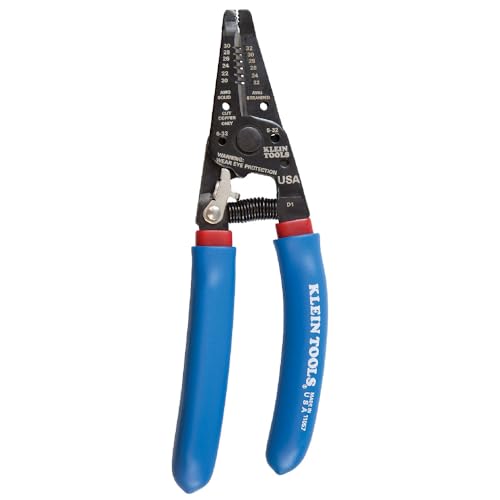
- Handles 20-30 AWG solid and 22-32 AWG stranded wire
- Features precision-ground stripping holes and clear markings
- Also cuts, loops, bends, and shapes wire
Best For: Small-wire electrical repairs and installations
Best Precision Wire Stripper for General Electronics – ENGINEER PA-06
The ENGINEER PA-06 is a practical choice among precision wire strippers when you need controlled stripping on small solid and stranded conductors. Its sharp high-carbon steel jaws, spring-loaded action, and soft TPR grip are suited to electronics and repair work where avoiding copper damage matters.
Best For: Electronics repair and professional users working with solid wire from AWG 28 to 16 or stranded wire from AWG 30 to 18.
Pros:
- Sharp jaws provide a clean insulation cut without damaging the conductor.
- Handles both small solid and stranded wire sizes.
- Spring-loaded design reduces hand effort and latches closed for storage.
- Oil-resistant TPR handles provide a comfortable, nonslip grip.
Cons:
- Its size range is intended for thin wires rather than larger household cable.
- It is a dedicated precision tool, not an automatic stripper.
Choose the PA-06 if your projects center on small-gauge wiring and you value precise, repeatable stripping over broad cable capacity.
Best Compact Combination Tool – Hakko CHP CSP-30-1
The Hakko CHP CSP-30-1 combines a wire stripper, shear, and pliers in one compact tool. It is a useful option among precision wire strippers for small-gauge work when you also want serrated gripping surfaces and soft rubber handles.
Best For: Light electronics and repair tasks involving 30- to 20-gauge wire, especially when stripping, cutting, and gripping are needed in one tool.
Pros:
- Combines stripping, shearing, and plier functions.
- Heat-treated alloy steel is built for strength and durability.
- Serrated jaws provide a firm grip on wires.
- Rounded rubber handles support a secure hold.
Cons:
- Its maximum stated capacity is limited to 30-20 gauge wire.
- It offers fewer specialized precision features than the dedicated ENGINEER models.
The Hakko is a sensible multipurpose pick when minimizing the number of tools matters more than covering the widest range of thin-wire sizes.
Best Precision Wire Stripper for Micro-Thin Wire – ENGINEER PA-14
The ENGINEER PA-14 is designed for micro-thin conductors, making it one of the more specialized precision wire strippers in this group. Its sharp round finishing edge and high-carbon steel jaws are intended to remove insulation neatly without deforming the wire core.
Best For: Fine electronics and repair work using solid wire from AWG 32 to 20 or stranded wire from AWG 34 to 22.
Pros:
- Supports especially fine solid and stranded wire sizes.
- Sharp jaws are designed for clean stripping without core damage.
- Spring-loaded handles make repeated use easier.
- Soft, oil-resistant TPR grips are comfortable to hold.
Cons:
- Its micro-wire focus makes it less suitable for heavier conductors.
- It is a specialized hand stripper rather than an automatic tool.
If your work involves very fine electronic wiring, the PA-14 offers a more targeted size range than general-purpose precision strippers.
Best Budget Precision Wire Stripper – DOWELL 22-30 AWG
The DOWELL 22-30 AWG stripper is a straightforward option for electronics engineering, repair, and DIY tasks. Among precision wire strippers, it stands out for combining insulation removal with wire cutting, a safety lock, and an ergonomic TPE handle.
Best For: Budget-conscious users working with 22- to 30-gauge wires who want a simple stripper and cutter for repair tasks.
Pros:
- Strips wires across a 22-30 AWG range.
- Can cut copper and fine iron wires.
- Safety lock helps protect the tool when stored.
- Stainless-steel construction and ergonomic TPE handle support regular use.
Cons:
- Its listed stripping range is narrower than the ENGINEER PA-06 and PA-14.
- The notes do not specify a spring-loaded mechanism or conductor-protection edge.
The DOWELL is a practical value pick for routine thin-wire work when basic stripping and cutting functions are more important than specialized finishing features.
Best Adjustable Pick – Jonard Tools ST-500 Precision Wire Stripper
The Jonard Tools ST-500 is a compact choice for precision wire strippers when you need controlled stripping on very small 20–30 AWG wires. Its adjustable stop supports consistent strip lengths from 0.039 to 2 inches.
Best For: Electronics work, small-gauge wiring, and applications requiring repeatable strip lengths.
Pros:
- Strips 20–30 AWG wires with a purpose-built mechanism.
- Adjustable stop supports precise lengths from 0.039 to 2 inches.
- Lightweight 1-ounce ABS design with a hardened steel blade.
Cons:
- Its 20–30 AWG range is narrower than the ranges of the other options.
- Compact design may be less suitable for heavier-duty wire work.
Choose this model when accuracy and repeatability matter more than broad gauge coverage. Its small, lightweight format is especially practical for detailed wiring tasks.
Best Value Set – DOWELL 2-Piece Precision Wire Stripper Set
The DOWELL two-piece set gives precision wire strippers broader coverage by pairing tools for 10–22 AWG and 22–30 AWG wires. Clearly marked stripping holes, built-in cutters, and spring-loaded handles make it a versatile option for routine electrical work.
Best For: General electrical maintenance, construction tasks, and users who want coverage across common wire sizes.
Pros:
- Covers both 10–22 AWG and 22–30 AWG solid and stranded wires.
- Precision stripping holes have easy-to-read markings.
- Includes induction-hardened cutters, serrated noses, spring-loaded handles, and safety locks.
Cons:
- The two-piece set takes more storage space than a single stripper.
- At 0.24 kg, it is heavier than the compact Jonard model.
This is a practical pick when versatility and included features are priorities. The paired gauge ranges reduce the need to switch between unrelated tools during everyday wiring jobs.
Best Automatic Option – KNIPEX Automatic Wire Stripper
The KNIPEX Automatic Wire Stripper is designed for users who want an automatic stripping action across 10–24 AWG wire sizes. Its 7.25-inch format and ergonomic plastic handle suit repeated work in shop, service, fleet, and plant-maintenance settings.
Best For: Repetitive wire-stripping tasks and maintenance work involving 10–24 AWG wires.
Pros:
- Automatic operation supports consistent stripping across 10–24 AWG.
- Made as a precision-grade tool for shop, home, or service use.
- Ergonomic handle and tested durability support regular use.
Cons:
- It is limited to 10–24 AWG, so it does not cover the smallest 30 AWG wires.
- Its 5.6-ounce weight and 7.25-inch size are less compact than the Jonard stripper.
Consider the KNIPEX when automatic operation and a proven trade-tool design are more important than ultra-compact size. It offers a focused gauge range for repeated maintenance work.
Best Precision Pick – KATA 20-32 AWG Precision Wire Stripper
For delicate electronics work, the KATA is a focused precision wire stripper covering 20-30 AWG solid wire and 22-32 AWG stranded wire. Its compact format and sharp, heat-treated carbon-steel cutting edge suit controlled stripping on low-voltage projects.
Best For: Electronics benches, 3D printer repairs, LED projects, models, guitar pickup rewiring, and other low-voltage DIY work.
Pros:
- Supports small 20-32 AWG wire sizes.
- Combines stripping, cutting, clamping, and insulation-terminal crimping.
- Compact 7-inch design with an ergonomic grip.
- Useful for hobby and maker toolkits.
Cons:
- Not intended for household power wiring.
- Wire size should be confirmed before use.
This is a practical choice when precision and control matter more than handling larger electrical conductors. Its stated low-voltage focus makes it especially appropriate for electronics and maker applications.
Best Heavy-Duty Automatic – Klein Tools 11063W Automatic Stripper
The Klein Tools 11063W is a heavy-duty automatic wire stripper and cutter for 8-20 AWG solid wire and 10-22 AWG stranded wire. Its cast-alloy chassis and heavy-duty finish make it a suitable precision wire stripper for demanding electrical work within that range.
Best For: Electrical work requiring automatic stripping and cutting of medium-gauge solid or stranded wire.
Pros:
- Handles 8-20 AWG solid and 10-22 AWG stranded wire.
- Automatic stripping and cutting design.
- Cast-alloy chassis provides durability and corrosion resistance.
- Backed by a Klein Tools warranty against quality or workmanship defects.
Cons:
- Does not cover the smallest wire sizes handled by dedicated electronics strippers.
- Heavy-duty construction may be more tool than light hobby tasks require.
Choose this model when durability and automatic operation take priority. Its wire-size range is better suited to general electrical applications than very small electronics wiring.
Best Manual Precision Tool – Klein Tools 11057 Wire Stripper
The Klein Tools 11057 is a manual precision wire stripper for 20-30 AWG solid wire and 22-32 AWG stranded wire. Precision-ground stripping holes, easy-to-read markings, and a spring-assisted opening make it well suited to repeatable small-wire preparation.
Best For: Electrical repairs, installations, and small-wire tasks requiring stripping, cutting, looping, bending, or pulling.
Pros:
- Supports 20-30 AWG solid and 22-32 AWG stranded wire.
- Precision-ground stripping holes help match wire sizes.
- Serrated nose supports bending, shaping, and pulling wire.
- Includes looping holes, screw shearing, and coil-spring self-opening action.
Cons:
- Manual design requires the user to position and operate the tool for each strip.
- Its stated wire range is focused on smaller conductors rather than heavy-gauge cable.
This is a versatile option for users who want more than stripping from a precision wire stripper. The integrated nose, looping features, and screw-shearing capability make it useful for broader electrical repair tasks.
How We Picked the Best Precision Wire Strippers
We focused on tools designed for small conductors, especially those covering roughly 20–32 AWG ranges. Selection criteria included stated solid and stranded-wire capacity, stripping consistency, jaw or blade design, grip comfort, spring action, locking features, durability, and suitability for electronics or light-duty wiring.
Because wire sizes and insulation types vary, a tool with the widest advertised range is not automatically the best choice. A well-matched fixed-gauge stripper can provide cleaner, faster results than an adjustable or automatic model when you repeatedly work with the same wire.
Quick Comparison
| Best For | Recommended Type | What to Look For |
|---|---|---|
| Micro-thin electronics wire | Fixed-gauge precision stripper | AWG 30–34 capability and sharp, accurately sized openings |
| Several small wire sizes | Adjustable precision stripper | Secure adjustment and clear size markings |
| Fast repetitive work | Automatic stripper | Consistent clamping, clean release, and suitable insulation range |
| Mixed workshop tasks | Multi-range stripper/cutter | Broad capacity, comfortable handles, and reliable cutters |
Key Buying Factors for Precision Wire Strippers
Wire Gauge and Conductor Type
Check whether the listed range applies to solid wire, stranded wire, or both. Stranded conductors may require different openings because their overall diameter and flexibility differ from solid wire. Choose a tool that places your usual gauge near the middle of its range rather than at its extreme limit.
Stripping Control
Fixed-gauge jaws are often the most predictable for repeated work, while adjustable models are more versatile. Automatic strippers can save time, but their clamping and blade mechanisms must match the insulation thickness. For delicate assemblies, controlled hand pressure and a positive spring return are valuable.
Build Quality and Ergonomics
Look for hardened or carbon-steel cutting surfaces, accurately machined jaws, a non-slip grip, and a spring that opens smoothly. A safety lock helps with storage, while compact designs are easier to use inside crowded enclosures. Avoid excessive handle flex, rough pivots, or jaws that do not align evenly.
Cutting and Extra Functions
Some models also cut wire, but cutting capacity may differ from stripping capacity. Confirm the manufacturer’s specifications before using a tool on harder materials or larger conductors. Integrated cutters are convenient, though dedicated cutters may be preferable for frequent heavy use.
Who Should Buy Which Precision Wire Strippers?
Choose a fixed-gauge model if you repair electronics or repeatedly strip one narrow wire size and want maximum consistency. An adjustable option suits technicians and hobbyists who handle several micro-wire gauges. Automatic models are a better fit for repetitive harness work or larger batches, provided their range matches your insulation and conductor types.
For a general workshop, choose a broader-range tool that combines stripping and cutting. If you work mainly with extremely thin conductors, prioritize the smallest supported AWG rating, jaw precision, and control over speed. Whichever design you select, test it on scrap wire first and verify that the copper remains unmarked after stripping.