The best printmaking press gives experienced artists more control over pressure, registration, paper size, and repeatability. The right choice depends on whether you primarily make linocuts, relief prints, etchings, or mixed-media impressions.
We selected 10 manual and tabletop options ranging from compact hand presses to larger slab and etching-style machines. Use the guide below to compare formats and identify the press that fits your studio, workflow, and typical print size.
Best 10 Printmaking Presses for Experienced Artists Picks for 2026
Compact A3 Starter

- Tabletop steel-frame design
- Supports several relief techniques
- Includes brayer and felt sheet
Best For: Compact A3 block-printing projects
Low-Effort Workbench Press

- Heavy-duty steel construction
- Uniform pressure with less effort
- Folds for compact storage
Best For: Mounted lino-printing workstations
Adjustable Heavy-Duty Option
Portable Adjustable Slab Roller Press
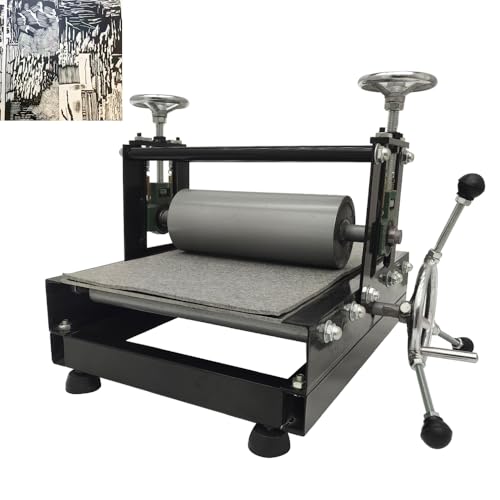
- Manual, no-electricity operation
- Adjustable roller height
- Large handwheel for pressure control
Best For: Relief, gravure, and embossed artwork
Wide A3 Studio Press

- A3W 11.75-by-16.3-inch format
- Uniform pressure with low effort
- Mountable and foldable design
Best For: Wider-format lino printing
Best Adjustable Compact Press

- Three adjustable pressure settings
- Stable stainless steel frame
- Compact tabletop design
Best For: A4 relief printing and mixed craft use
Best Heavy-Duty Folding Press

- Large 19-by-12.5-inch format
- Heavy-duty steel construction
- Folds for compact storage
Best For: Larger lino prints and established studio setups
Best Large-Format Value Press

- A3 format for larger projects
- Stable birch plywood body
- Includes basic printing accessories
Best For: Portable A3 linocut and woodblock printing
Compact Etching Workhorse

- Supports prints up to 9 × 15 inches
- Includes felt pad and base plate
- Steel construction with smooth roller
Best For: Small-format home studios and mixed-technique printmaking
Lever-Controlled Linocut Tool

- Fits blocks up to about 25 mm thick
- Designed for A4-size papers
- Includes roller, pads, and wrenches
Best For: Linocut and other small-format block printing
Heavy-Duty Roller Platform

- 19.7 × 12.6-inch panel
- 11-inch smooth, adjustable roller
- Adjustable anti-slip feet and iron frame
Best For: Dedicated studios needing a larger tabletop press
Compact A3 Starter – Green Linocut Press
For experienced artists seeking printmaking presses for experienced artists, this tabletop lino press offers a compact manual setup for relief, lino, woodcut, and rubber-block work. Its A3 format, steel frame, plywood plates, and included brayer make it a practical option for controlled block printing without electricity.
Best For: Artists who want a compact A3 tabletop press for varied relief-printing techniques.
Pros:
- Supports lino, woodcut, rubber-block, relief, and block printing.
- Steel frame and beech wood handle provide manual pressure control.
- Includes a 6 cm rubber brayer and felt sheet.
- Available in sizes from A5 through A3.
Cons:
- Manual operation requires the artist to supply the pressing effort.
- The listed A3 working dimensions may not suit larger-format projects.
This press is a flexible tabletop choice when workspace and storage matter. The coated plywood plates are designed to help distribute pressure evenly, while the included accessories support immediate block-printing setup.
Low-Effort Workbench Press – Woodzilla Turquoise 19 x 12.5
For experienced artists comparing printmaking presses for experienced artists, the Woodzilla 19-by-12.5-inch press emphasizes uniform pressure with a heavy-duty steel construction. It mounts to a table or workbench and folds for storage, making it suited to artists who want a dedicated but space-conscious lino-printing setup.
Best For: Lino printers who prioritize consistent pressure, mounting stability, and compact storage.
Pros:
- Heavy-duty steel design is intended to apply uniform pressure.
- Designed for low-effort operation.
- Can be mounted to a table or workbench.
- Foldable and fitted with anti-skid shoes to help protect surfaces.
Cons:
- Mounting may be less convenient for artists without a suitable workbench.
- Its 29.1-pound weight makes it less portable than a lightweight tabletop press.
Made in the Netherlands, this Woodzilla model is a strong fit for a permanent or semi-permanent studio station. Its combination of mountability, folding storage, and uniform-pressure design favors repeatable lino-printing sessions.
Adjustable Heavy-Duty Option – Portable Adjustable Slab Roller Press
Among printmaking presses for experienced artists, this manual slab roller-style machine stands out for its adjustable roller height and large handwheel. Its nearly 19.7-by-12.6-inch panel supports relief, gravure, and embossed artwork, while adjustable feet and a painted iron frame are intended for stable tabletop use.
Best For: Experienced makers needing adjustable pressure control for relief, gravure, or embossed work.
Pros:
- Manual operation requires no electricity.
- Adjustable roller height accommodates different material thicknesses.
- Large handwheel and enlarged roller are designed to improve pressure consistency.
- Adjustable anti-slip feet support stability on a table.
Cons:
- At 48.9 pounds, it is relatively heavy for a portable machine.
- The machine’s broader footprint may require substantial tabletop space.
- Its slab-roller format may be more specialized than a simple lino press.
This is the most adjustment-focused option in the group. Artists working across different plate thicknesses or embossed processes may value the spiral-screw pressure adjustment, while the weight favors a stable studio location over frequent transport.
Wide A3 Studio Press – Woodzilla Mint A3W Press
Woodzilla Press for Lino Printing, A3W 11.75" x 16.3" - Mint - Made in Netherlands
Check Price On AmazonFor experienced artists looking at printmaking presses for experienced artists, this mint Woodzilla press provides a wider A3-oriented format measuring 11.75 by 16.3 inches. Its heavy-duty steel construction is designed for uniform pressure, while table mounting, anti-skid shoes, and a foldable design support organized studio use.
Best For: Artists who want a wider Woodzilla format for A3 lino-printing projects.
Pros:
- Designed to produce uniform pressure with low effort.
- Heavy-duty steel construction supports regular studio use.
- Can mount to a table or workbench.
- Folds between uses and includes anti-skid shoes.
Cons:
- Requires a suitable table or workbench for mounting.
- The larger format may need more storage space than a smaller press.
- The supplied notes do not specify the product weight.
Choose this model when the wider A3 format is more important than maximum portability. Its foldable construction helps offset the larger footprint, and the low-effort pressure design is suited to repeat printing sessions.
Best Adjustable Compact Press – A4 Beech Wood Linocut Press
For artists comparing printmaking presses for experienced artists, this A4 manual model offers a compact tabletop format with adjustable pressure for relief-printing projects. Its beech wood pressure plate and handle, stainless steel frame, and felt pad are designed for controlled, even impressions.
Best For: Artists and printmakers who want a compact press for A4 linocut, woodcut, letterpress, rubber printing, and craft projects.
Pros:
- Three pressure settings accommodate blocks up to 25 mm thick.
- Solid beech wood components provide a smooth, burr-free working surface.
- Thickened 304 stainless steel frame is designed for stability and corrosion resistance.
- Wear-resistant shaft sleeve and felt pad support smoother operation and even ink transfer.
Cons:
- A4 capacity is more limited than larger-format presses.
- Manual lever operation requires the artist to supply the pressing force.
This is a practical choice when adjustable pressure and a small studio footprint matter most. Experienced artists working on larger blocks may prefer a wider press, but for standard A4 work and varied craft applications, its sturdy construction and pressure control are useful advantages.
Best Heavy-Duty Folding Press – Woodzilla 19-Inch Lino Press
Woodzilla Press for Lino Printing, 19" x 12.5" - Dark Green - Made in Netherlands
Check Price On AmazonAmong printmaking presses for experienced artists, the Woodzilla stands out for its larger 19-by-12.5-inch format and heavy-duty steel construction. It is engineered to provide uniform pressure with less effort and can be mounted to a table or workbench for a more secure setup.
Best For: Experienced linocut artists who need a larger working area, low-effort pressure, and a press that can be stored compactly between sessions.
Pros:
- 19-by-12.5-inch format supports larger lino-printing projects.
- Heavy-duty steel design applies uniform pressure without undue strain.
- Mountable to a table or workbench for a stable working position.
- Folds for space-saving storage, while anti-skid shoes help protect surfaces.
Cons:
- Mounting may be less convenient for artists who need a completely portable setup.
- Its larger dimensions require more workspace during use than compact tabletop presses.
Woodzilla is the strongest fit here for artists prioritizing format and pressing efficiency over the smallest footprint. Its foldable design helps offset the size, making it a capable studio press for regular lino-printing sessions.
Best Large-Format Value Press – AsellPress A3 Linocut Press
For artists seeking printmaking presses for experienced artists, the A3 AsellPress offers a larger format in a compact manual design. Its birch plywood body is built for stability, while consistent hand pressure is intended to produce sharp, clean linocut and woodblock impressions.
Best For: Artists, students, and hobbyists who need A3 capacity for relief printing in a home studio, classroom, or workshop.
Pros:
- A3 size accommodates larger projects than A4 and A5 versions.
- Birch plywood body is designed to be strong, stable, and durable.
- Lightweight tabletop construction supports portable use across studios or classrooms.
- Includes a felt pad, lino sheet, and six carving tools for getting started.
Cons:
- Manual pressing requires consistent hand pressure from the user.
- The supplied notes do not specify adjustable pressure settings.
- A3 format takes more working space than the smaller available options.
The A3 AsellPress is a sensible option when project size is more important than advanced adjustment features. It combines a larger print area with a portable body and useful included accessories, making it adaptable for developing or established relief-printing practices.
Compact Etching Workhorse – Basic Etching Printing Press
For artists comparing printmaking presses for experienced artists, this compact steel etching machine offers broad technique support without demanding much studio space. Its felt pad, base plate, and smooth roller make it a practical choice for small-format work up to 9 × 15 inches.
Best For: Home studios, workshops, schools, and artists creating etchings, embossing, block prints, monotypes, lithographs, or relief prints in a compact format.
Pros:
- Supports multiple printmaking techniques and prints up to 9 × 15 inches.
- Heavy-duty steel construction and a smooth roller help deliver even pressure.
- Includes a felt pad and base plate for immediate setup and added cushioning.
- Rotating L-shaped handle is designed to reduce hand pressure during extended use.
Cons:
- Its supported print size is smaller than that of larger studio presses.
- At 18.5 pounds, it is portable for a press but not especially lightweight.
This is a sensible small-format option when versatility, included accessories, and storage-friendly dimensions matter more than maximum bed size. Experienced artists should confirm that its 9 × 15-inch capacity matches their usual work.
Lever-Controlled Linocut Tool – TOPOWN Hand Lever Press
Among printmaking presses for experienced artists, the TOPOWN hand lever model stands out for block-focused work and straightforward pressure control. Its three-level adjustment accommodates blocks up to about 25 mm thick, while the lever transfers pressure evenly across A4-size papers.
Best For: Linocut, woodcut, letterpress, rubber, cork, cardboard, and other block-printing projects using A4-size paper.
Pros:
- Three-level adjustment supports blocks up to approximately 25 mm thick.
- Manual lever design is intended to make pressing more even and less strenuous.
- Includes a rubber roller, felt pad, rubber pad, and wrenches.
- Powder-coated alloy-steel frame is paired with a high-density plywood handle and plate.
Cons:
- Blocks are not included.
- Its A4 compatibility and 12 × 11.5-inch footprint limit larger-format work.
- The design is specialized toward block and relief printing rather than broad press-bed applications.
Choose this press if your practice centers on hand-carved blocks and you value an accessible lever mechanism. Its included accessories reduce setup friction, but artists working beyond A4 should consider a larger press.
Heavy-Duty Roller Platform – PreAsion Etching Press
For experienced artists evaluating printmaking presses for experienced artists, the PreAsion Etching Press provides a larger, table-mounted roller platform with adjustable feet and pressure control. Its 11-inch-long, 3.9-inch-diameter roller is designed for smooth contact, while the handwheel regulates movement and pressure.
Best For: Artists needing a substantial tabletop press for printmaking, rubbing, and artwork projects involving paper, wood, plaster, or slabs.
Pros:
- Large 19.7 × 12.6-inch panel provides more working area than compact presses.
- Thick, smooth roller is designed to support even pressure and cleaner prints.
- Four adjustable anti-slip feet help stabilize the press on a table.
- Painted iron frame and sturdy PVC layout are built for durability and rust resistance.
Cons:
- At 58.9 pounds, it is substantially heavier and less convenient to move.
- The overall dimensions require considerable table and storage space.
- The supplied notes do not specify included accessories such as felt or plates.
This model makes the most sense for a dedicated workspace where stability and a larger panel outweigh portability. Its adjustable feet and roller-height adjustment add flexibility, but plan for a sturdy table and sufficient room.
How We Picked the Best Printmaking Presses for Experienced Artists
We focused on practical factors that matter after an artist has moved beyond occasional craft use: usable bed size, pressure control, construction, portability, and compatibility with common relief or intaglio techniques. The selection includes dedicated lino presses, lever-operated hand presses, slab-roller-style machines, and basic etching presses so you can compare different approaches rather than only similar models.
Because specifications and included accessories can vary by seller, confirm the current dimensions, materials, roller or platen configuration, and maximum paper capacity before ordering. A press should match both your largest planned work and the thickness of your blocks, blankets, plates, or other substrates.
Quick Comparison
- Best for larger lino work: A3 and 19-inch Woodzilla-style presses provide generous working areas for oversized relief prints.
- Best for compact studios: A4 and tabletop hand presses take up less room and are easier to store between sessions.
- Best for portability: Manual lever and compact plywood presses are simpler to move than full etching machines.
- Best for broader experimentation: Etching presses with a bed, felt, and base plate may support more than standard block printing, depending on their pressure range.
Key Buying Factors for Printmaking Presses for Experienced Artists
Bed Size and Print Format
Choose a bed that comfortably exceeds your largest block and leaves room for registration margins. A3-class models suit many studio projects, while 19-inch presses are more useful for wide compositions. If nearly all your work is small-format, a compact A4 press may provide better value and easier handling.
Pressure and Control
Even pressure is essential for consistent ink transfer. Look for a rigid frame, stable platen or roller, and an adjustment system that lets you fine-tune pressure without excessive force. For layered or multi-color work, repeatable movement and predictable pressure are often more important than maximum size.
Construction and Stability
Wooden presses can be attractive and relatively light, but they still need a solid base and minimal flex. Check how the press is supported on a table and whether clamps or mounting hardware are recommended. A heavier etching-style machine may be preferable when stability matters more than portability.
Technique Compatibility
Confirm that the press is intended for your process. Dedicated linocut presses are straightforward for relief printing, whereas etching presses may offer a broader working range but require more setup and space. Do not assume that a press designed for lino will safely handle metal plates or unusually thick materials.
Workspace and Maintenance
Measure the complete footprint, including handles and clearance for loading paper. Also consider storage, cleaning access, replacement parts, and whether blankets, plates, or a base are included. These details can affect the real cost and convenience more than the advertised press price.
Who Should Buy Which Printmaking Presses for Experienced Artists?
Choose an A3 or 19-inch press if you routinely print larger blocks, need generous registration space, or want room to grow. Choose an A4 or compact hand press for smaller editions, limited workspaces, or a setup that can be packed away easily.
Choose a lever-style press when portability and direct control are priorities. Choose a slab-roller or etching-style machine if you want to explore multiple printmaking methods and have a stable workspace for a larger, more involved setup. Experienced artists should prioritize rigidity, repeatability, and technique compatibility over decorative finishes or the lowest upfront price.