When it comes to woodworking tools, understanding the nuances is essential for achieving great results.
In this article, we will explore the differences between a wood planer and a thickness planer, helping you decide which tool is right for your projects.
What are the Main Functions of Wood Planers and Thickness Planers?
Wood Planer
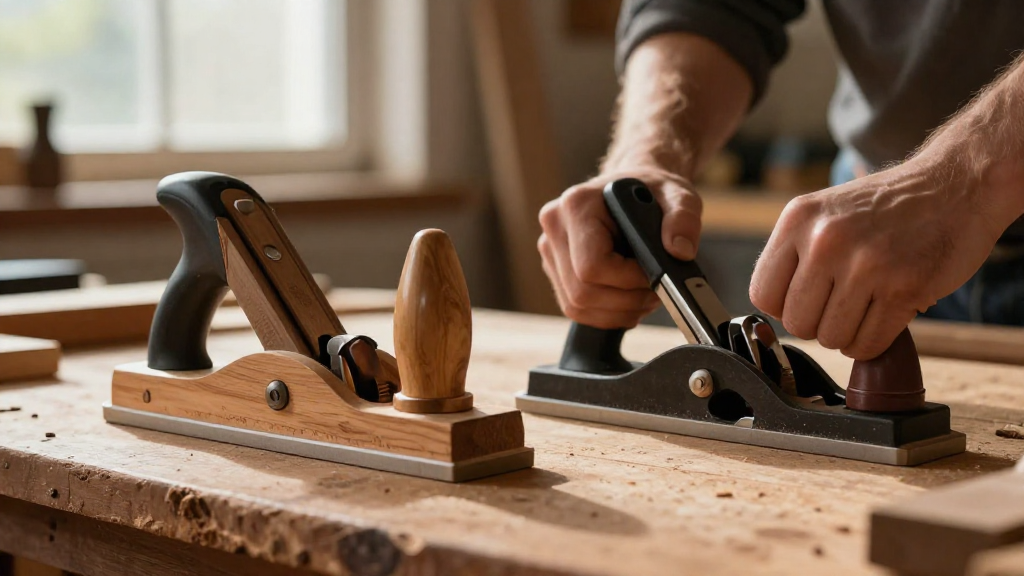
A wood planer, often referred to as a hand plane or jointers planer, serves several critical functions in woodworking:
-
Smoothing rough lumber: It removes imperfections and creates a smooth, flat surface.
-
Beveling edges: It allows you to create angled edges on your boards for specific joints.
-
Creating specific profiles: Various types of wood planers can produce different shapes and designs.
Thickness Planer
A thickness planer is a more specialized tool dedicated to ensuring uniform board thickness.
Here are its primary functions:
-
Creating consistent thickness: It removes material from the faces of boards to achieve the desired thickness.
-
Flattening warped wood: A thickness planer can help flatten edges that are bowing or twisted.
-
Preparing wood for projects: Ideal for pre-finishing tasks, ensuring boards are even for assembly.
How Do Wood Planers Work?
The Mechanics of Wood Planer
A wood planer operates by using a set of sharp blades that cut into the surface of the wood as you move it through the tool.
The mechanism is relatively simple:
-
Adjustable depth settings allow the user to control how much material is removed with each pass.
-
The blades shave off thin layers, which creates a smooth finish.
The Mechanics of Thickness Planer
In contrast, a thickness planer works by pulling the wood through a set of stationary blades.
Here’s how it operates:
-
The feed rollers pull the wood through, ensuring smooth, uninterrupted passes.
-
The cutting heads (or knives) remain fixed, allowing for consistent measurement across the entire surface.
-
Users can adjust the height of the infeed and outfeed tables to determine the thickness.
Which Tool Should You Choose: Wood Planer vs Thickness Planer?
What are Your Specific Needs?
When deciding between a wood planer vs thickness planer, the first question to ask is what your specific woodworking needs are.
-
For making wood smooth: If your primary goal is to flatten, smooth, or shape wood surfaces, a wood planer may be your best bet.
-
For achieving uniform thickness: If you need to ensure that your boards are uniformly thick, especially for precise assemblies, a thickness planer is indispensable.
What is the Size of Your Projects?
The size of your projects can also influence your decision.
-
Smaller Projects: If you primarily work on small projects, a wood planer is typically more manageable and portable.
-
Larger Projects: For larger boards or extensive woodworking operations, a thickness planer can save you time and effort.
Do Planers Have Different Types?
What Types of Wood Planers Exist?
Wood planers come in several variants:
-
Hand Planes: Ideal for small jobs or detailed work.
-
Electric Planers: Offer more power and speed for larger tasks.
-
Bench Planers: Fixed equipment used for consistent, larger-scale work.
What Types of Thickness Planers Can You Find?
There are also different types of thickness planers:
-
Portable Thickness Planers: Great for easy transport and ideal for small shops.
-
Stationary Thickness Planers: Offer a larger capacity and are designed for heavy-duty work.
-
Benchtop Thickness Planers: Compact models that are perfect for hobbyists.
What are the Cost Considerations?
Is There a Big Price Difference?
When comparing wood planers vs thickness planers, it’s important to consider your budget.
-
Hand and electric wood planers typically range from $50 to $300, depending on features.
-
Thickness planers usually start around $250 and can go up to $1200 or more for professional-grade options.
What is the Cost-Effectiveness?
While the initial cost may be a concern, consider the long-term savings:
- Using a tool that suits your needs best will save both time and material costs in the long run.
Can You Use These Tools Together?
How Do They Complement Each Other?
For serious woodworking enthusiasts, using both a wood planer and a thickness planer is often the best approach.
These tools can significantly improve the quality and efficiency of your projects.
-
First Step: Use a wood planer to flatten and smooth rough lumber.
-
Second Step: Follow up with a thickness planer to achieve a uniform height across all boards.
What About Safety Measures?
Are There Specific Safety Tips to Consider?
Regardless of your tool of choice, safety should always be a priority.
Here are key safety tips:
-
Always wear safety goggles to protect your eyes.
-
Keep your hands clear of the cutting area.
-
Use push sticks or pads to guide the wood through the machines.
-
Always read the manufacturer’s manual for specific safety recommendations.
Conclusion: Which is Right for You?
In the debate of wood planer vs thickness planer, determining which tool best suits your needs boils down to your specific objectives.
If you aim to smooth and shape wood, go for a wood planer.
But if your focus is uniformity in thickness, a thickness planer is the way to go.
Many woodworkers find that having both tools enhances their workflow and improves project outcomes.
Make an informed decision based on your projects, budget, and working style, and enjoy the quality craftsmanship that comes with the right tools!