The right dress form can make pattern drafting, draping, fitting, and garment presentation far easier for a fashion student. The best choice depends on your size range, workspace, assignment requirements, and whether you need a pinnable sewing form or a display mannequin.
We compared 10 options across adjustability, stability, pinnability, scale, portability, and value to help you choose a practical form for studio work, coursework, and early design projects.
Best 10 Dress Forms for Fashion Students Picks for 2026
Top Adjustable Pick
Dritz Sew You Adjustable Dress Form

- 12 adjustment points for detailed fitting
- Adjustable height and 360-degree hem marker
- Fits approximately US women's sizes 4–12
Best For: Students needing flexible fitting and draping adjustments
Lightweight Display Option

- Height adjusts from 60 to 67 inches
- Lightweight four-pound foam torso
- Wood tripod suits displays and home studios
Best For: Portable garment display, photography, and basic pinning
Advanced Fitting Choice
Dritz My Double Designer Dress Form

- 12 rolling wheels with inch and centimeter markings
- Torso extension and offset pole support pants fitting
- Lockable wheeled base improves studio mobility
Best For: Students handling tailored garments and detailed fitting projects
Plus-Size Tripod Form

- Designed for approximately size 14–16 garments
- Height adjusts from 60 to 75 inches
- Lightweight foam-and-linen body with wood tripod
Best For: Students needing a taller, larger-size display and pinning form
Best Adjustable Fit
SINGER Female Adjustable Dress Form

- 12 dials adjust key body measurements
- Pinnable foam-backed flannel exterior
- Includes 360-degree hem gauge
Best For: Adult-size projects in sizes 10–18
Best Display-Ready Option

- Pinnable foam torso with linen cover
- Adjustable 31–45.8-inch height
- Stable rectangular base for display
Best For: Size 6–8 garments and studio presentation
Best for Scale Practice
1/3 Scale Dress Form Mannequin
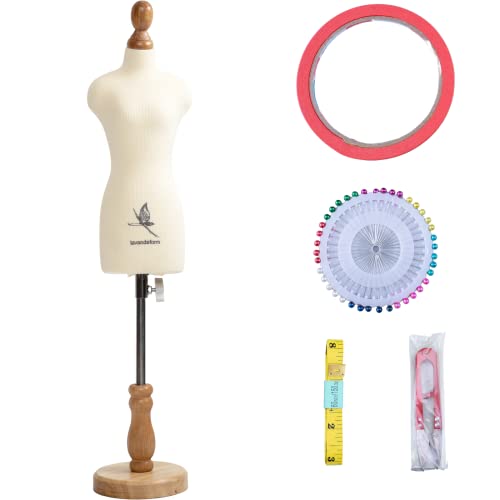
- Compact 1/3-scale torso for design practice
- Fully pinnable fabric-covered surface
- Includes measuring and marking accessories
Best For: Reduced-scale pattern making and draping exercises
Best Lightweight Display Form

- Height adjusts from about 60–75 inches
- Pinnable styrofoam body with linen exterior
- Lightweight, tool-free assembly
Best For: Displaying and pinning size 6–8 garments
Best Adjustable Sewing Form

- 13 dials adjust body, neck, and height
- Supports sizes 4–14 and pinning practice
- Stable tripod for draping and display
Best For: Multi-size fitting, tailoring, and draping practice
Best Simple Display Mannequin

- Height adjusts from 58–67 inches
- Lightweight styrofoam body and tripod stand
- Works for dresses, tops, jackets, and accessories
Best For: Portable display of finished garments
Top Adjustable Pick – Dritz Sew You Adjustable Dress Form
For fashion students seeking dress forms for fashion students projects, the Dritz Sew You offers extensive adjustability in a compact small/medium size range. Its multiple dials, adjustable height, and hem marker support fitting, draping, pinning, and measuring.
Best For: Students sewing garments for bodies approximately within US women’s sizes 4–12 who want precise manual adjustments.
Pros:
- 12 multi-point adjustments and nine smooth-rolling wheels help match body measurements.
- Adjustable center pole reaches up to 62.5 inches for shoulder-to-floor matching.
- 360-degree hem marker supports more accurate garment finishing.
- Foam-backed surface accepts pins at an angle, and the stand needs no tools for setup.
Cons:
- Its stated size range is limited to approximately US women’s sizes 4–12.
- The plastic construction may feel less substantial than heavier studio forms.
This is a strong choice for students who prioritize fitting flexibility and a project-friendly design. The opal green finish also makes it suitable for displaying work between sewing sessions.
Lightweight Display Option – FDW Female Mannequin Torso
The FDW Female Mannequin Torso is a straightforward option for fashion students comparing dress forms for fashion students coursework, displays, photography, or basic pinning. It combines a foam torso with a wooden tripod and offers seven inches of height adjustment.
Best For: Students who need a lightweight, movable form for standard-size garments, presentation, or home-studio use.
Pros:
- Height adjusts from 60 to 67 inches.
- High-density foam and a fabric-covered surface support pinning.
- Wood tripod and stainless steel tube provide a sturdy base.
- Weighs four pounds and assembles without tools.
Cons:
- It has fixed torso measurements rather than multi-point body adjustments.
- The stated measurements may not suit garments outside its approximately 34.6-inch chest and 25.6-inch waist.
- Its 90-day manufacturer warranty is relatively limited.
Choose this model when portability and presentation matter more than fine-grained fitting control. Its black finish and home-decor-friendly appearance also work well for displaying completed pieces.
Advanced Fitting Choice – Dritz My Double Designer Dress Form
For fashion students who need dress forms for fashion students assignments involving tailored garments, the Dritz My Double Designer provides detailed sizing control and improved mobility. Its rolling base, torso extension, offset pole, and hem marker are useful for more involved construction work.
Best For: Students developing pants, jackets, gowns, and other garments requiring extended fitting and positioning options.
Pros:
- 12 soft-grip rolling wheels provide marked bust, waist, and hip adjustments.
- Up to two inches of torso-length extension supports more accurate proportions.
- Offset center pole accommodates pants fitting, with height up to 74 inches when offset.
- Lockable wheeled base makes the form easier to move while maintaining stability.
Cons:
- Its small size is intended for approximately US women’s sizes 4–14.
- The added rolling-base and adjustment features may be more than beginners need.
This is the most versatile option in the group for students working across multiple garment types. The pin cushion, foam-backed surface, and printed 360-degree hem marker add practical studio functionality.
Plus-Size Tripod Form – Bonnlo Female Dress Form
Bonnlo Female Dress Form Pinnable Mannequin Body Torso with Wooden Tripod Base Stand (Beige, 14-16)
Check Price On AmazonThe Bonnlo Female Dress Form gives fashion students a larger torso option when comparing dress forms for fashion students projects. Its linen-covered foam body, adjustable height, and wooden tripod support pinning, garment display, and basic draping.
Best For: Students working with approximately size 14–16 garments who want a lightweight form with a taller height range.
Pros:
- Adjusts from 60 to 75 inches for flexible working height.
- Foam core and linen covering create a clean, pinnable surface.
- Wooden tripod with 2.75-inch-thick supports is designed for stability.
- At 6.4 pounds, it remains relatively easy to move and assembles without tools.
Cons:
- It does not provide the multi-point adjustment dials found on the Dritz forms.
- The supplied notes list differing body measurements, so students should verify the specific fit before buying.
- Pins need to be inserted at an angle.
The Bonnlo is a practical larger-size alternative for display and basic garment work. Its broad height range is useful in a student workspace, though the fixed torso proportions make measurement checking especially important.
Best Adjustable Fit – SINGER Female Adjustable Dress Form
For fashion students seeking dress forms for fashion students projects in a standard adult size range, the SINGER adjustable form offers broad fitting flexibility. Its 12 dials adjust the neck, bust, waist, hips, and height for pattern draping, alterations, and garment development.
Best For: Students working on adult garments in sizes 10–18 who need detailed fit adjustments and a hem guide.
Pros:
- Adjusts across bust sizes 40–46 inches, waist sizes 31–37 inches, and hips 40–46 inches.
- Foam-backed flannel surface is designed for pinning patterns and fabric.
- Includes a 360-degree hem gauge and tool-free height adjustment.
- Assembles without tools and can also display finished outfits.
Cons:
- Its Medium/Large range may not suit smaller student-size projects.
- At 11 pounds, it is less lightweight than a reduced-scale form.
This is a practical full-size option when adjustable measurements matter more than portability. The broad size range and hem gauge make it especially useful for repeated fitting and finishing exercises.
Best Display-Ready Option – VINGLI Female Dress Form
The VINGLI is a useful choice among dress forms for fashion students who want a pinnable torso for clothing design, fitting, and presentation. Its size 6–8 body combines a linen cover with an adjustable stand and stable rectangular base.
Best For: Students developing or displaying smaller women’s garments in studios, shows, or home workspaces.
Pros:
- Pinnable foam body with a soft linen exterior supports basic draping and fitting.
- Height adjusts from 31 to 45.8 inches.
- Rectangular base is designed to remain stable under heavier clothing.
- Lightweight construction and tool-free assembly make it easy to move and set up.
Cons:
- Its fixed size 6–8 measurements offer less fitting flexibility than a dial-adjustable form.
- The torso dimensions may not accommodate garments outside its listed bust, waist, and hip measurements.
Choose this model when a straightforward, attractive display form is as important as pinning capability. It provides a stable setup for student garments without the adjustment complexity of a multi-dial form.
Best for Scale Practice – 1/3 Scale Dress Form Mannequin
For fashion students learning pattern making and draping, this 1/3-scale mannequin offers a compact way to practice reduced-scale garment development. The fully pinnable polyurethane torso includes an adjustable support assembly and accessories for classroom or studio exercises.
Best For: Students practicing scaled pattern development, draping, fitting demonstrations, and sample construction where a full-size form is unnecessary.
Pros:
- Compact 1/3-scale format is suited to reduced-scale design and draping exercises.
- Fabric-covered polyurethane torso accepts pins directly.
- Overall height adjusts from approximately 21.3 to 27.2 inches.
- Includes thread snips, measuring tape, pins, and red marking tape.
Cons:
- It is explicitly not a full-size dress form.
- The small 29-centimeter bust, 23-centimeter waist, and 30.5-centimeter hip measurements limit full-size fitting work.
- Marking tape must be applied by the user.
This form is best viewed as a focused learning tool rather than a substitute for an adult mannequin. Its small footprint and included accessories make it well suited to experimenting with proportion, draping, and pattern concepts.
Best Lightweight Display Form – Adjustable Female Dress Form
For fashion students who need dress forms for fashion students’ projects, this lightweight Bonnlo form offers a simple setup for displaying garments and practicing with pins. Its linen exterior, adjustable stand, and size 6–8 measurements make it especially suitable for smaller designs and classroom or studio use.
Best For: Displaying and lightly pinning size 6–8 garments in a studio, bedroom, or classroom.
Pros:
- Adjustable height from approximately 60 to 75 inches.
- Strong styrofoam body allows pins to be inserted.
- Rubber wood tripod and stainless steel tube support heavier garments.
- Tool-free assembly and lightweight construction make it easy to move.
Cons:
- Its listed measurements are limited to a size 6–8 form.
- The manufacturer advises holding the wood section when moving it.
This is a practical pick when portability and garment display matter most. Students working with larger or variable sizes may prefer an adjustable multi-size form instead.
Best Adjustable Sewing Form – Multi-Size Dress Form
Among dress forms for fashion students, this Bonnlo model is the most flexible for fitting practice because its 13 dials adjust the body and neck. The foam-backed flannel surface is designed for pinning, while the tripod base supports cutting, draping, tailoring, and garment display.
Best For: Students practicing fitting and draping across sizes 4–14.
Pros:
- Adjustable bust, waist, hips, neck, and height using 13 dials.
- Accommodates a listed size range of 4–14.
- Foam-backed flannel exterior makes pinning straightforward.
- Stable tripod base supports heavy outfits without being bulky.
Cons:
- Manual adjustments require setting multiple dials for each size.
- The supplied details identify it as a small-size model with specific measurement ranges.
Its broad adjustment range makes this the strongest option for coursework involving multiple body measurements. It also remains useful after class for displaying finished garments.
Best Simple Display Mannequin – Brown Female Dress Form
For fashion students seeking dress forms for fashion students’ presentations or garment displays, this brown mannequin keeps the setup simple. Its adjustable tripod reaches 58–67 inches, and the lightweight styrofoam body is suited to showcasing tops, dresses, jackets, and accessories.
Best For: Lightweight display of finished garments in windows, on counters, or on the floor.
Pros:
- Adjustable height from 58 to 67 inches.
- Solid tripod and metal tube provide support for the torso.
- High-density styrofoam construction keeps the form lightweight.
- Assembles and disassembles without tools.
Cons:
- The supplied notes emphasize display rather than a pinnable surface.
- Its height range is narrower than the other adjustable models listed here.
This mannequin is a sensible choice for students who need a movable presentation stand rather than a highly adjustable sewing form. The brown finish can also provide contrast for lighter garments.
How We Picked the Best Dress Forms for Fashion Students
We focused on the features that matter most in a student studio: usable size adjustment, a stable stand, a surface suitable for pinning, clear measurement controls, and enough flexibility for draping and fitting exercises. We also included different formats, from full-size adjustable forms to compact torsos and a 1/3-scale model for pattern-making practice.
Because student needs vary, the lineup includes both sewing-focused forms and display-oriented mannequins. A form that works well for draping may not be the best choice for presenting finished clothing, so we considered each design’s likely use rather than treating all mannequins as interchangeable.
Quick Comparison
| Best For | Look For |
|---|---|
| Beginning sewing students | Simple dials, adjustable sizing, and a pinnable body |
| Advanced draping practice | Stable construction, broad adjustment range, and a useful hem guide |
| Small workspaces | Torso-style construction or a compact tabletop form |
| Garment display | A finished exterior, attractive stand, and reliable height adjustment |
| Pattern-making exercises | A scale form with consistent proportions and easy repositioning |
Key Buying Factors for Dress Forms for Fashion Students
Adjustability and Size Range
Choose a form that covers your usual pattern size and allows enough adjustment for the assignments you expect to complete. Multiple dials can help fine-tune the bust, waist, and hips, but adjustment points may create uneven contours if expanded too far. Check the listed size range and compare it with your body measurements or course requirements.
Pinnability and Surface Design
For muslin fitting and draping, a pinnable surface is usually more useful than a smooth display shell. Confirm that the product is designed for pins before buying; some mannequins are intended mainly for displaying finished garments and may be difficult or unsafe to pin.
Stand Stability and Height
A tripod should remain steady while you pull fabric, place pins, or rotate the form. Height adjustment is particularly important for skirt and dress hems. Look for a stand that reaches a comfortable working height without becoming top-heavy.
Scale, Storage, and Portability
A full-size form is the most versatile for garment fitting but requires dedicated floor space. Torso models are easier to store, while a 1/3-scale form can support classroom exercises without taking over a desk. Consider the base footprint and how often you will transport the form between home and campus.
Who Should Buy Which Dress Forms for Fashion Students?
Choose an adjustable sewing form if you are learning garment construction, draping, or fitting and need one tool that can support several projects. Choose a pinnable torso with a wood stand if stability, presentation, and a smaller footprint matter most. Choose a display mannequin for showcasing completed garments rather than frequent pinning or detailed fitting work.
Choose the 1/3-scale option if you are practicing pattern manipulation, miniature draping, or classroom demonstrations and need a compact, lower-cost supplement. Students working on dresses and long garments should prioritize a stable full-size stand with height adjustment and, ideally, a hem-level guide.