The right quilting frame can make long stitching sessions more comfortable, keep fabric tension consistent, and give you a cleaner working surface. Adjustable designs are especially useful when you need to change the frame height, angle, or footprint for different projects.
We selected 10 adjustable quilting frames ranging from compact lap and tabletop hoops to full-size floor systems. Use the guide below to compare their construction, adjustability, portability, and best use cases before choosing.
Best 10 Adjustable Quilting Frames Picks for 2026
Best Adjustable Floor Frame
- 39-by-28-inch quilting area
- 30- to 37-inch height adjustment
- Lightweight, compact PVC design
Best For: Seated or standing quilting with a roomy work surface
Best Adjustable Hoop Stand

- 360-degree rotation and tilt
- Height adjusts to 37.5 inches
- Folds to 16 inches for storage
Best For: Portable hand quilting from an easy chair
Best No-Baste Frame

- No tacks or tape required
- Three ratchet wheels control tension
- Folds for compact storage
Best For: Quilters prioritizing easy fabric setup and tension
Best Full-Size Frame
Edmunds American Legacy Quilt Frame

- 24-by-90-inch full-size setup
- Shortens to 24 by 45 inches
- Suitable for solo or group quilting
Best For: Large quilt projects needing a spacious frame
Best Beginner Pick

- Works with many 8- to 13-inch-throat machines
- Up to an 11-by-15-inch quilting area
- Designed for beginners and small projects
Best For: Beginning quilters using a domestic machine
Best Lightweight Hoop
- Lightweight PVC tubing construction
- Clamps hold fabric around the frame
- 17-by-17-inch square working size
Best For: Portable fabric stretching and stitching
Best Adjustable Stand

- Adjusts to different heights and widths
- Includes an 8.5-by-24-inch scroll frame
- Leaves both hands free for stitching
Best For: Seated quilting at home or on the go
Best Fold-Away Frame

- Works with a compatible sewing machine
- Up to 36-inch quilting width
- Folds away for storage
Best For: Home quilters wanting frame-style quilting without a dedicated longarm
Best Portable Lap Frame

- 14-by-14-inch square frame
- Supports quilt-as-you-go projects
- Disassembles for travel
Best For: Small lap quilts and portable quilting sessions
Best Large Floor Frame

- 38.9-by-29-inch rectangular format
- Supports thicker, larger fabrics
- Works for quilting and embroidery
Best For: Large fabric projects needing floor-standing support
Best Adjustable Floor Frame – Dritz Quilter's Floor Frame
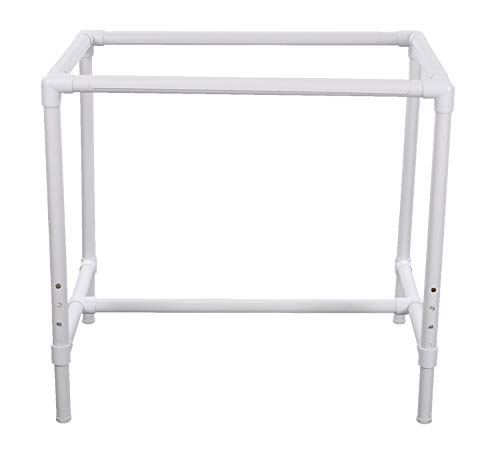
The Dritz Quilter’s Floor Frame is a practical choice among adjustable quilting frames for anyone who wants a roomy work surface with flexible height and angle settings. Its lightweight PVC construction is designed for straightforward setup, portability, and compact storage.
Best For: Quilters who want a spacious frame for seated or standing work.
Pros:
- 39-by-28-inch working area provides ample quilting space.
- Height adjusts from 30 to 37 inches, with four leg angles.
- Lightweight PVC design assembles easily and stores compactly.
- Fabric-tension covers help keep quilt layers smooth and secure.
Cons:
- PVC construction may feel less substantial than a heavier frame.
- The frame requires assembly before use.
With its broad surface and multiple positioning options, this floor frame offers useful flexibility for quilting at different heights. It is especially appealing when portability and storage convenience matter.
Best Adjustable Hoop Stand – Quilters Wonder! 18-Inch Hoop
The Frank A. Edmunds Quilters Wonder! combines an 18-inch hoop with a height-adjustable stand, making it one of the more flexible adjustable quilting frames for chair-side projects. The hoop rotates and tilts 360 degrees, while the stand folds down for storage.
Best For: Hand quilters who prefer a portable hoop that can be used from an easy chair.
Pros:
- Full 360-degree rotation and tilt improve access to the quilt.
- Height adjusts up to 37.5 inches for comfortable positioning.
- Three-pronged knobs make adjustments easy.
- Lightweight design folds to 16 inches for storage.
Cons:
- The 18-inch hoop offers less working area than a full-size frame.
- Its stand-based hoop format may not suit large quilt layouts.
This frame stands out for positioning flexibility rather than maximum capacity. Its rotating hoop and compact folded size make it a convenient option for smaller hand-quilting sessions.
Best No-Baste Frame – Grace Start-Right EZ3
The Grace Start-Right EZ3 is a sturdy option among adjustable quilting frames for quilters who want to install fabric without tacks or tape. Its three ratchet wheels provide front-to-back tension, while the foldable plywood-and-aluminum design is suited to convenient storage.
Best For: Quilters seeking a no-baste setup with controlled fabric tension.
Pros:
- Installs fabric without tacks or tape.
- Three 30-tooth ratchet wheels provide front-to-back tension.
- Dense Baltic birch plywood and aluminum rails create a sturdy frame.
- Folds for storage against a wall or under a bed.
Cons:
- At 20 pounds, it is heavier than the lightweight portable frames in this roundup.
- The notes do not specify adjustable height or tilt settings.
The EZ3 focuses on secure fabric installation and tension control rather than broad positional adjustment. Its folding construction helps offset the heavier materials when storage space is limited.
Best Full-Size Frame – Edmunds American Legacy Quilt Frame
The Edmunds American Legacy is a full-size choice among adjustable quilting frames, offering a 24-by-90-inch setup for individual or group quilting. Its detachable rods allow the frame to be configured at either full length or a shorter 45-inch length.
Best For: Single quilters or groups working on larger quilt projects.
Pros:
- Full-size 24-by-90-inch frame accommodates broad quilt layouts.
- Can be shortened to 24 by 45 inches.
- Detachable rods support configuration changes.
- Includes instructions for setup and use.
Cons:
- The full-size footprint requires substantial floor space.
- The notes do not identify height, tilt, or other ergonomic adjustments.
This frame is designed around capacity and flexibility in length rather than compact portability. Choose it when a large working area is more important than a small storage footprint.
Best Beginner Pick – Mini Quilter Tabletop Frame
The Mini Quilter is a practical entry point for anyone comparing adjustable quilting frames for use with a domestic sewing machine. It is designed to simplify the learning process and works with most machines having an 8- to 13-inch throat length.
Best For: Beginning quilters and small quilting projects.
Pros:
- Designed to make hoop-frame quilting easier to learn.
- Works with many domestic sewing machines.
- Provides up to an 11-by-15-inch quilting area.
- Includes a one-year warranty.
Cons:
- The quilting area is limited compared with larger frames.
- Actual quilting space may be smaller with a smaller sewing machine.
Choose this frame if you want a structured way to learn long-arm techniques without replacing your current machine. Its compact quilting area is better suited to smaller projects than full-size quilts.
Best Lightweight Hoop – Q-Snap 17-Inch Frame
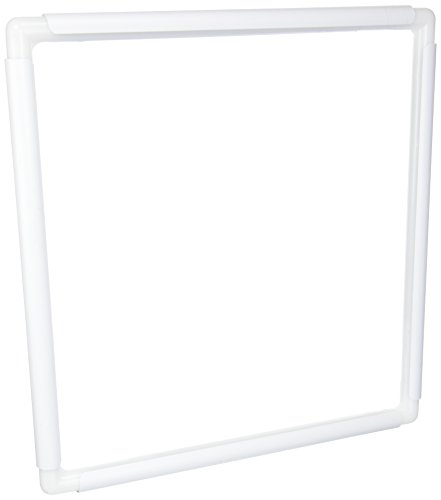
The Q-Snap 17 by 17-Inch Frame is a simple option among adjustable quilting frames for holding fabric taut during hand quilting or other stitching work. Its PVC tubing keeps the frame lightweight, while the clamps secure fabric around the outside.
Best For: Quilters who want a lightweight, square frame for fabric stretching and stitching.
Pros:
- Lightweight at 12.64 ounces.
- PVC construction is described as durable.
- Clamps stretch fabric around the frame.
- Offers a 17-by-17-inch working size.
Cons:
- The fixed 17-by-17-inch size may not suit every project.
- It is a basic frame rather than a stand-based setup.
This Q-Snap is a good fit when portability and straightforward fabric tension matter most. Consider another style if you need height adjustment or a larger, furniture-style quilting frame.
Best Adjustable Stand – Edmunds Lap and Table Frame
Frank A. Edmunds 5850 Adjustable Lap & Table Stand with Scroll Frame, 8.5" X 24"
Check Price On AmazonThe Frank A. Edmunds 5850 stands out among adjustable quilting frames because its lap-and-table stand can be adjusted to different heights and widths. The included 8.5-by-24-inch split-rail scroll frame leaves both hands free for stitch control.
Best For: Quilters who work from a chair, couch, bed, table, or while traveling by car.
Pros:
- Allows two-handed stitching for better control.
- Adjusts to different heights and widths.
- Fits fabric up to 21 inches wide.
- Usable in several seating and tabletop locations.
Cons:
- Not recommended for thicker fabrics such as burlap.
- The included frame is limited to an 8.5-by-24-inch format.
This is the most versatile choice of the three for seated quilting and flexible placement. Its adjustable stand is useful for changing work positions, though heavy or thick fabrics are outside the stated recommendation.
Best Fold-Away Frame – FreeWay Frame
The Handi Quilter FreeWay Frame is a practical choice for quilters seeking adjustable quilting frames without purchasing a dedicated longarm machine. It lets a compatible sewing machine glide side to side and front to back, offering up to 36 inches of quilting width and 15 inches of depth, depending on the machine’s throat depth.
Best For: Quilters who want frame-style free-motion quilting with an existing sewing machine and need a setup that folds away for storage.
Pros:
- Uses a compatible sewing machine you already own.
- Provides smoother machine movement with less fabric wrestling.
- Sets up on a table and folds away when finished.
- Includes carriage components, quilt clamps, and rubberized clamps.
Cons:
- Sewing machine is sold separately.
- Requires a table at least 50 inches wide.
- Compatibility depends on the machine’s footprint and needle-plate height.
With its fold-away design, broad machine compatibility, and included clamps, the FreeWay is a versatile option for home quilters who want more control without committing to a full longarm setup. Its five-year structural coverage requires product registration.
Best Portable Lap Frame – Quilt-N-Go Lap Frame
The Dritz Quilt-N-Go is a compact option for shoppers comparing adjustable quilting frames for lap-style projects. Its 14-by-14-inch square format is designed for quilt-as-you-go work and can be assembled or disassembled for storage and travel.
Best For: Quilters who prefer small lap projects, portable crafting, or the quilt-as-you-go method.
Pros:
- Designed specifically for quilt-as-you-go and lap quilting.
- Compact 14-by-14-inch working size.
- Easy to assemble and disassemble.
- Lightweight at 12 ounces.
Cons:
- Smaller than floor and machine-frame alternatives.
- Not intended for large quilt sections.
- No warranty is listed.
The Quilt-N-Go prioritizes portability and simplicity over workspace. Its compact PVC construction makes it suitable for taking projects on the go, though larger quilts will require a more substantial frame.
Best Large Floor Frame – BEN YEDD Quilter's Frame
The BEN YEDD Quilter’s Floor Frame is a large support option for those comparing adjustable quilting frames for embroidery, patchwork, and cross-stitch projects. Its rectangular 38.9-by-29-inch design uses metal and PVC components and is described as suitable for thicker and larger fabrics.
Best For: Crafters who need a floor-standing support frame for larger or thicker fabric projects.
Pros:
- Large rectangular working footprint.
- Suitable for thicker and larger fabrics.
- Can support quilting, embroidery, patchwork, and cross-stitch work.
- Combines metal and PVC construction.
Cons:
- Requires floor space for its larger format.
- Assembly details are not specified in the supplied information.
- No warranty is listed.
This BEN YEDD frame is best suited to projects that benefit from a larger support area rather than a compact lap setup. Its broad footprint may be useful for heavier fabrics, but shoppers should plan for dedicated floor space.
How We Picked These Adjustable Quilting Frames
We focused on frames that offer meaningful flexibility for quilters, including adjustable height, angle, hoop position, frame width, or setup style. The selection covers lap frames, tabletop hoops, floor-standing systems, scroll frames, and fold-away free-motion designs so you can match the format to your workspace and quilting method.
We also considered practical factors such as stability, portability, fabric access, assembly, storage, and suitability for beginners. Because quilting preferences vary, no single frame is ideal for every project; the best choice depends on quilt size, stitch technique, and available room.
Quick Comparison
| Frame type | Best for | Main advantage | Watch for |
|---|---|---|---|
| Lap frame or hoop | Small projects and portable work | Compact and easy to use while seated | Limited quilting area |
| Tabletop frame | Beginners and small workspaces | Lower footprint and convenient access | Needs a sturdy table |
| Floor frame | Large quilts and extended sessions | More working area and adjustable positioning | Requires storage space |
| Scroll frame | Organized fabric progression | Keeps sections rolled and manageable | May require more setup |
| Fold-away frame | Free-motion quilting and shared rooms | Can be stored between sessions | Confirm machine and quilt compatibility |
Key Buying Factors for Adjustable Quilting Frames
Size and Quilt Capacity
Check the frame’s hoop or roller dimensions and compare them with the size of your quilt. A compact 14- to 18-inch frame can be convenient for blocks, borders, and smaller quilts, while full-size frames are better for keeping more of a large quilt supported at once.
Adjustability and Comfort
Look for height and angle adjustments that let you work with relaxed shoulders and a neutral wrist position. Adjustable Quilting Frames should also hold their settings securely; frequent slipping can disrupt tension and become frustrating during long sessions.
Stability and Fabric Tension
A broad base, solid joints, and a rigid hoop or roller help prevent movement. For hand quilting, consistent tension is particularly important. If you plan to use a frame with a sewing machine, verify that the structure provides adequate clearance and does not interfere with the machine’s movement.
Portability and Storage
Lap and tabletop models are easiest to move and store, while floor frames provide more workspace but occupy more room. Fold-away construction is useful if the frame must be put away after each session.
Assembly and Materials
Review the expected assembly and the frame’s materials before buying. Wood can provide a traditional, substantial feel, while plastic or composite components may reduce weight. Replacement parts and clear instructions can also matter for long-term use.
Who Should Buy Which Adjustable Quilting Frames?
Choose a lap hoop or compact tabletop frame if you are a beginner, work on small quilts, or need a portable setup. A Q-Snap-style frame can suit users who want quick fabric changes and a simple tensioning system.
Choose a floor-standing frame if you regularly hand quilt larger projects and have dedicated workspace. These models generally provide better access and positioning options for longer sessions. A scroll frame is a practical middle ground when you want to advance fabric in organized sections.
If free-motion work or machine quilting is your priority, look for a design specifically built around machine clearance and movement. Finally, confirm dimensions, adjustment ranges, and weight limits before ordering, especially when pairing the frame with a particular quilt thickness or sewing machine.