A small garage can trap vehicle fumes, dust, sawdust, paint odors, and airborne particles long after a project ends. The right air purifier can improve air quality without taking up valuable floor or workbench space.
These 10 picks cover compact HEPA units, higher-airflow filtration systems, and specialized odor-control equipment. Match the purifier’s airflow, filter design, and operating requirements to your garage size and the contaminants you need to address.
Best 10 Garage Air Purifiers for Small Garages Picks for 2026
Best Compact Pick

- 255-square-foot coverage
- Quiet 25 dB operation
- 3-in-1 filter for dust, smoke, and odors
Best For: Small garages needing compact, quiet air cleaning
Best Odor Treatment

- Treats spaces up to 900 square feet
- 400 mg/h ozone output with 80 CFM fan
- Designed for unoccupied-space odor treatment
Best For: Periodic odor treatment when the garage is empty
Best Higher-Coverage Filtered Pick

- 143 CFM CADR
- 3-in-1 filtration with tested 99.97% efficiency
- 24 dB Sleep Mode and timer
Best For: Occupied garage workspaces needing stronger filtered airflow
Best Workshop Airflow
WEN 3410 Air Filtration System
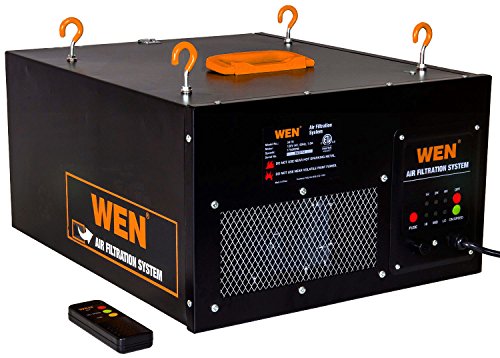
- 300/350/400 CFM airflow
- 1-micron filter and 5-micron pre-filter
- Remote control with programmable timer
Best For: Small workshop garages where airborne dust circulation is the priority
Wide-Intake Garage Coverage

- Wide intake and coverage up to 2,200 sq. ft.
- Washable pre-filter plus Pet Mode
- PM2.5 display and six operating modes
Best For: Small garages needing odor control and visible air-quality monitoring
Fast Compact Filtration

- Three-layer HEPA and activated-carbon filtration
- Purifies a 215 sq. ft. room in about 15 minutes
- 20 dB operation, timers, and two-year warranty
Best For: Small garages needing quiet, quick everyday filtration
Ultra-Quiet 360° Airflow
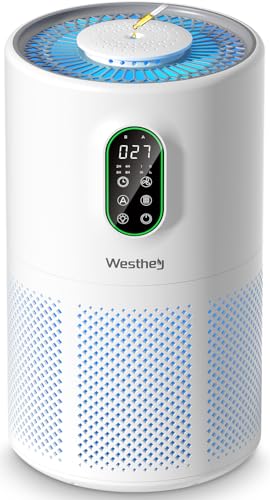
- 360° intake with coverage up to 1,650 sq. ft.
- H13 HEPA filtration and PM2.5 display
- Sleep mode rated as low as 15 dB
Best For: Small garages near living areas where quiet operation matters
Compact Quiet Pick
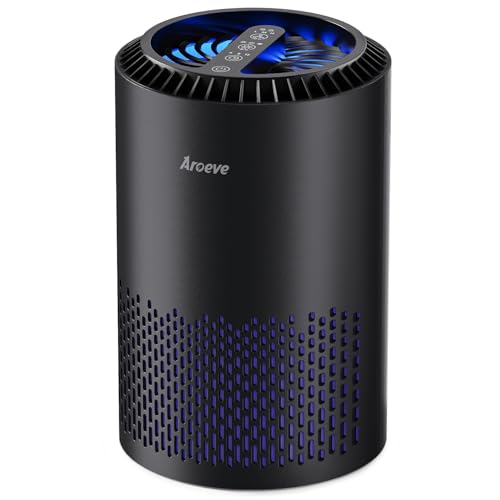
- Compact body for space-limited garages
- 360-degree intake with 287 sq. ft. coverage
- Quiet 22 dB sleep mode
Best For: Small garages needing a quiet, compact purifier
High-Coverage Choice
MOOKA Large-Room HEPA Purifier

- Rated coverage up to 2,200 sq. ft.
- Three-stage filtration with activated carbon
- PM2.5 sensor and automatic fan mode
Best For: Large or multipurpose garages with odors and changing air quality
Verified Performance Pick

- AHAM Verified for dust, smoke, and pollen
- 4.8 ACH in a 209 sq. ft. room
- True HEPA, carbon, and PM2.5 auto mode
Best For: Small garages where verified performance and automation matter
Best Compact Pick – Levoit Core Mini-P
For shoppers seeking garage air purifiers for small garages, the Levoit Core Mini-P is a compact, low-power option for light dust, smoke, odors, and pet-related particles. Its 255-square-foot coverage, 7-watt draw, and 25 dB noise rating make it practical for a small workspace or hobby area.
Best For: Small garages where compact size, quiet operation, and basic multi-stage filtration matter most.
Pros:
- Compact 6.5-by-6.5-by-10.4-inch design weighs just 2.2 pounds.
- 3-in-1 filtration addresses dust, smoke, odors, pet dander, and pollen.
- Quiet 25 dB operation with auto-off display and sleep mode.
- AHAM, ETL, and Energy Star certified, with a two-year warranty.
Cons:
- Its 255-square-foot coverage is intended for smaller areas.
- Its compact 7-watt design is not suited to heavy-duty workshop dust collection.
The Core Mini-P is a sensible choice when you need unobtrusive air cleaning in a small garage rather than a high-airflow workshop unit. Use it to supplement good ventilation and source control.
Best Odor Treatment – OdorStop OS900/6G
The OdorStop OS900/6G takes a different approach to garage air treatment, using a 400 mg/h ozone generator and an 80 CFM fan for spaces up to 900 square feet. It is designed for deodorizing small to medium areas, but its operating requirements make it a specialized option rather than a general-purpose occupied-space purifier.
Best For: Unoccupied garages needing periodic odor treatment for smoke, mold, animals, cooking, or other persistent smells.
Pros:
- Rated for treatment areas of 900 square feet or more.
- 400 mg/h ozone output and 80 CFM fan target difficult odors.
- Two-hour timer, hold option, folding handle, and replaceable charcoal filter.
- Compact aluminum housing weighs six pounds and requires no assembly.
Cons:
- Ozone is for use in unoccupied spaces only.
- It is not appropriate for routine air cleaning while people or pets are present.
- Amazon policy prohibits sale of ozone products to California.
This unit may be useful for scheduled odor treatment, but it requires strict attention to the supplied safety warning and adequate re-entry ventilation. Choose a conventional filtration purifier instead if the garage is occupied during operation.
Best Higher-Coverage Filtered Pick – Levoit Core 300-P
The Levoit Core 300-P is a stronger filtered-air option for garage air purifiers for small garages when you want more airflow and coverage than a desktop-size model. Its 143 CFM CADR, 3-in-1 filtration, and 24 dB Sleep Mode suit a garage that doubles as a workspace, provided the environment is within its intended indoor-use context.
Best For: Small to medium garage workspaces needing higher airflow for dust, pollen, smoke, pet dander, and odors.
Pros:
- 143 CFM CADR with listed coverage up to 1,073 square feet.
- 3-in-1 filter offers 99.97% filtration efficiency for tested 0.1-to-0.3-micron airborne particulates.
- Quiet 24 dB Sleep Mode, timer settings, and switchable display lights.
- AHAM, CARB, and ETL certified.
Cons:
- At 8.7 by 8.7 by 14.2 inches and 7.9 pounds, it is less compact than the Core Mini-P.
- The supplied notes specify 120V use in the United States.
- Replacement filters should be genuine Levoit filters for the stated fit and performance.
With substantially more motor power and airflow than the Core Mini-P, the Core 300-P is the better fit for a garage used regularly as a hobby or work area. It remains an air purifier, not a substitute for dust extraction at the tool.
Best Workshop Airflow – WEN 3410 Air Filtration System
The WEN 3410 is a workshop-oriented air filtration system for shoppers comparing garage air purifiers for small garages with conventional room purifiers. It moves 300, 350, or 400 CFM through a 5-micron pre-filter and 1-micron filter, making it suited to airborne workshop dust in spaces up to 400 square feet.
Best For: Small garages used for woodworking or hands-on projects where high airflow, remote control, and ceiling or elevated placement are useful.
Pros:
- Three airflow settings up to 400 CFM.
- Includes replaceable 1-micron filter and 5-micron pre-filter.
- Remote works from up to 26 feet and does not require direct line of sight.
- Programmable timer automatically shuts the unit off.
Cons:
- Large 17-by-20.5-by-10-inch housing weighs 31 pounds.
- Noise is listed at 50 to 60 dB.
- Its 400-square-foot coverage is limited compared with the OdorStop’s stated treatment area.
The WEN 3410 is the most workshop-focused choice in this group, prioritizing circulation and filter capacity over portability and whisper-quiet operation. It is a practical complement to source capture, ventilation, and cleanup in a small garage shop.
Wide-Intake Garage Coverage – MOOKA PR1
For shoppers comparing garage air purifiers for small garages, the MOOKA PR1 stands out for its wide-sided air intake, washable pre-filter, and real-time PM2.5 display. Its multiple modes can help address dust, smoke, pet hair, and unpleasant odors in a garage or nearby room.
Best For: Small garages or connected spaces where washable pre-filter maintenance, odor control, and visible air-quality feedback are priorities.
Pros:
- Wide-sided air intake and a stated coverage area of up to 2,200 square feet.
- Four-stage filtration with a washable pre-filter and Pet Mode for hair and odors.
- PM2.5 sensor, automatic fan adjustment, timer, child lock, and six fan modes.
- Sleep mode operates as low as 26 dB; the unit is listed as ozone-free and certified by CARB, ETL, DOE, and FCC.
Cons:
- The manufacturer recommends replacing the filter every 3–6 months.
- The sensor requires regular cleaning for accurate readings, and the display may show a one-minute preheating period after startup.
- Its large-room rating may be more capacity than necessary for a very small garage.
The PR1 is a feature-rich choice if you want monitoring and flexible controls rather than a basic fan-and-filter setup. Its washable pre-filter may also be useful in dusty garage environments, provided the filter is fully dried before reuse.
Fast Compact Filtration – Purivortex PX500
The Purivortex PX500 is a practical contender among garage air purifiers for small garages when quick circulation and simple controls matter. It uses a three-layer filter with activated carbon and is rated to purify a 215-square-foot room in about 15 minutes under the manufacturer’s test conditions.
Best For: Small garages or compact work areas where quiet operation, odor reduction, and straightforward timer controls are useful.
Pros:
- Three-layer filtration combines a pre-filter, HEPA filter, and activated carbon for dust, smoke, pet dander, and light odors.
- Manufacturer states 99.97% filtration for particles as small as 0.1 microns, based on independent testing.
- Six-inch filter design provides nearly 1.5 times the filter area of typical four-inch filters of this size.
- Quiet operation is listed at 20 dB, with four fan modes, three timers, and a two-year warranty.
Cons:
- The listed 880-square-foot rating may be excessive for a very small garage and does not replace source ventilation for strong fumes.
- The notes describe activated carbon as helping with light household odors, so odor performance may be limited for heavy garage chemicals.
- Replacement-filter timing is not specified in the supplied details.
With its compact-oriented design, quiet rating, and carbon layer, the PX500 suits garages where you want routine particle and light odor filtration without a complicated control system. Keep expectations realistic around intense fumes or solvent vapors.
Ultra-Quiet 360° Airflow – WESTHEY AP02
If quiet operation is a priority when choosing garage air purifiers for small garages, the WESTHEY AP02 offers 360-degree air intake, automatic fan adjustment, and a sleep mode rated as low as 15 dB. Its washable pre-filter and H13 HEPA filter are suited to routine dust, smoke, dander, and odor reduction.
Best For: Small garages connected to living spaces where low noise, all-around intake, and automatic operation are important.
Pros:
- 360-degree air intake and stated coverage up to 1,650 square feet, with six air changes per hour in 275 square feet.
- H13 HEPA filtration is rated to capture 99.98% of 0.3-micron particles.
- PM2.5 display and Auto Mode provide real-time feedback and automatic fan-speed adjustment.
- Sleep mode can operate at 15 dB, with three fan speeds, four timer settings, and a washable pre-filter.
Cons:
- The large stated coverage rating may be more than a small garage requires.
- The manufacturer recommends replacing the filter every 3–6 months.
- Aromatherapy and colorful lighting may be unnecessary extras for a garage-focused setup.
The AP02 is a strong fit when you want unobtrusive operation and broad intake around the unit. Its low-noise sleep mode is especially useful if the garage adjoins a bedroom, office, or other frequently occupied space.
Compact Quiet Pick – AROEVE MK01A
For shoppers comparing garage air purifiers for small garages, the AROEVE MK01A is a compact option with 360-degree air intake and coverage rated for spaces up to 287 square feet. Its filter is designed to capture smoke, pollen, dander, hair, and other particles, while its low-power operation and small footprint suit limited spaces.
Best For: Small garages or adjacent work areas where quiet operation and compact sizing matter.
Pros:
- Compact 6.1-by-6.1-by-9.7-inch design is easy to place in a small garage.
- 360-degree air inlets and dual-channel circulation help refresh air throughout the rated space.
- Sleep mode operates at a reported 22 dB and includes an aroma pad for optional fragrance.
Cons:
- Coverage is limited to 287 square feet, so it is not suited to larger garages.
- The filter should be replaced every 3–6 months for optimal performance.
- It is a 120V corded unit intended for use in the United States.
The AROEVE is best viewed as a lightweight, quiet particle-focused purifier for a small enclosed garage rather than a heavy-duty workshop ventilation system. Its straightforward controls and small footprint make it practical when space is at a premium.
High-Coverage Choice – MOOKA Large-Room HEPA Purifier
Among garage air purifiers for small garages, this MOOKA model offers more coverage than a typical compact unit, with a stated rating of up to 2,200 square feet. Its three-stage filtration, activated carbon pellets, PM2.5 sensor, and auto mode make it a flexible choice for garages that also collect odors, pet hair, smoke, or dust.
Best For: Larger enclosed garages or multipurpose garage spaces needing automatic air-quality adjustment and odor support.
Pros:
- Large front and dual-side air inlets help draw in airborne hair, odors, smoke, and particles.
- Three-stage filtration includes a pre-filter, HEPA filter, and activated carbon pellets.
- PM2.5 monitoring and auto mode can adjust fan speed as air quality changes.
- Sleep mode reaches a reported 20 dB, with timers, a child lock, and a filter reminder.
Cons:
- Its large-room design may be more purifier than necessary for a very small garage.
- The supplied notes do not include the unit’s full dimensions or detailed CADR figures.
- The filter’s protective plastic must be removed before use.
This MOOKA stands out for garage users who want broad stated coverage and more automated controls. It can address particles and odors, but it should complement—not replace—safe ventilation when working with fumes or combustion sources.
Verified Performance Pick – AirHub AHAM Purifier
The AirHub is a compelling option for shoppers seeking garage air purifiers for small garages with independently verified performance. It is AHAM Verified for dust, smoke, and pollen removal, delivers 4.8 air changes per hour in a 209-square-foot room, and combines a washable pre-filter with True HEPA and activated carbon filtration.
Best For: Small enclosed garages where verified CADR performance, particle filtration, and automatic monitoring are priorities.
Pros:
- AHAM Verified performance includes stated 4.8 ACH in a 209-square-foot room.
- Three-stage filtration captures particles down to a stated 0.3 microns and helps reduce odors.
- Dual-sided intake, PM2.5 sensing, color-coded air-quality display, and auto mode support convenient operation.
- Sleep mode is rated at 20 dB, and the unit includes a timer, child lock, and filter reminder.
Cons:
- The 1,092-square-foot figure is based on 1 ACH, so smaller spaces may be the more appropriate comparison.
- The supplied notes do not provide the purifier’s dimensions.
- As with any particle purifier, it should not be treated as a substitute for ventilation around concentrated chemical or fuel fumes.
For a small garage, the AirHub’s AHAM verification and 209-square-foot performance reference offer useful buying benchmarks. Its washable pre-filter may also help with maintenance, while the sensor and auto mode reduce the need for constant manual adjustments.
How We Picked the Best Garage Air Purifiers for Small Garages
We compared the selected models by considering filtration type, stated coverage, airflow, controls, noise features, maintenance requirements, and suitability for a compact garage. Because manufacturer coverage ratings can use different testing assumptions, treat square-foot claims as a starting point rather than a guarantee.
For everyday dust, pollen, pet hair, and fine particles, we prioritized units with HEPA or HEPA-style filtration and washable pre-filters. Higher-airflow systems can make more sense for workshops, while ozone generators require special safety precautions and should never be operated around people, pets, or plants.
Quick Comparison
| Type | Best use | What to check |
|---|---|---|
| Compact HEPA purifier | General dust and allergen reduction | Replacement filter cost and airflow |
| High-airflow filtration system | Workshops and active projects | CFM, intake placement, and noise |
| Washable pre-filter model | Hair, sawdust, and coarse debris | Cleaning access and primary filter design |
| Ozone generator | Unoccupied odor-treatment sessions | Strict safety procedures and ventilation |
Key Buying Factors for Garage Air Purifiers for Small Garages
Airflow and Effective Coverage
Choose a unit capable of moving enough air for the garage’s actual volume, not just its floor area. A purifier with adjustable speeds lets you run quietly during regular use and increase airflow after dusty work. For workshop filtration, CFM is often more useful than a broad room-size claim.
Filter Construction
A washable pre-filter helps capture larger particles before they reach the main filter. HEPA filtration is generally the better choice for fine airborne particles, but it does not remove every gas or chemical vapor. Replace filters on schedule, especially if the garage has heavy dust or vehicle traffic.
Noise, Controls, and Placement
Sleep mode, remote controls, timers, and multiple fan speeds can make routine use easier. Keep the intake and outlet unobstructed, place the unit away from wet areas, and avoid positioning it where it can be struck by tools or vehicles.
Garage-Specific Safety
Air purifiers are not substitutes for ventilation, source control, or carbon-monoxide detection. Do not use a standard purifier to make an enclosed garage safe while an engine, fuel-burning appliance, paint, solvent, or adhesive is producing fumes. Ozone-generating equipment should only be used in an empty, sealed space according to the manufacturer’s instructions, followed by thorough ventilation.
Who Should Buy Which Garage Air Purifiers for Small Garages?
For everyday garage dust: Choose a compact HEPA purifier with a washable pre-filter and affordable replacement filters.
For a small workshop: Favor a higher-CFM filtration system that can circulate air quickly during sanding, cutting, or other dusty tasks.
For occasional odor treatment: Consider specialized equipment only if you understand its safety requirements; never treat ozone as a continuous-occupancy purifier.
For a garage connected to living space: Select a quiet, consistently operated HEPA unit and prioritize sealing, ventilation, and preventing contaminants from entering the home.