The right dress form makes fitting, draping, hemming, and pattern adjustments faster and more accurate. This roundup compares 10 options for home sewists, costume makers, and professional tailors.
We focus on adjustability, size coverage, pinning usability, stability, and practical features that help you match a form to the garments you make most often.
Best 10 Dress Forms for Tailoring Picks for 2026
Adjustable Fit Pick

- 13 multi-point adjustments with 12 auto-set dials
- Torso extension and height adjustment up to 66 inches
- Foam-backed pinning surface and 360° hem marker
Best For: Medium-size tailoring, fitting, and draping
Arm-Enhanced Tailoring Form
Size 2 Mannequin with Sewing Arms

- Includes soft long-sleeve sewing arms
- Height adjusts from 55 to 70 inches
- Metal stand and textured canvas covering
Best For: Small-size draping, sleeve work, and fashion training
Mobile Precision Pick

- 12 marked adjustment wheels for detailed fitting
- Lockable rolling base improves workspace mobility
- Torso extension and offset pole support pants work
Best For: Alterations, draping, and movable small-size fitting
Versatile Medium-Large Choice

- 12 dials cover neck, bust, waist, hips, and height
- Foam-backed flannel surface supports secure pinning
- 360° hem guide and tool-free setup
Best For: General dressmaking and alterations in sizes 10–18
Best Adjustable Male Form
Dritz Mr. Tailor Adjustable Dress Form

- 12 marked adjustment wheels for men’s sizing
- Centered or offset pole for varied garments
- Foam-backed, pinnable surface with adjustable height
Best For: Men’s tailoring from shirts and jackets to pants
Best Display-Oriented Torso
Female Dress Form Mannequin Torso

- Pinnable linen cover for basic draping
- 59- to 85-inch adjustable stand
- Compact half-body design for display and styling
Best For: Boutique display and fixed-size garment projects
Best Women’s Adjustable Form
Dritz Sew You Adjustable Dress Form
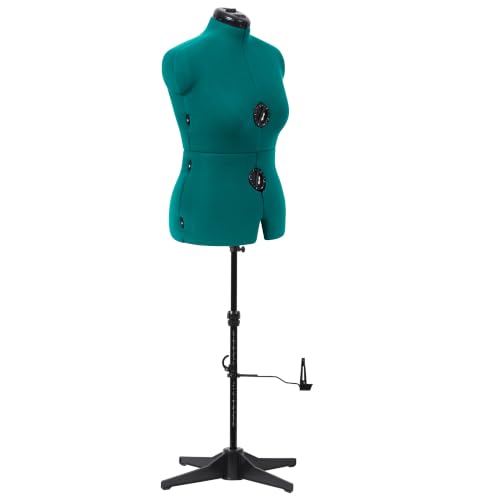
- 12 adjustment points for US women’s sizes 12-18
- 360-degree adjustable hem marker
- Foam-backed pinning surface and recordable settings
Best For: Repeatable fitting and hemming for women’s garments
Best Adjustable Range

- 13 adjusters for key body measurements
- Height adjusts up to 75 inches
- Flannel-covered body with hem marker
Best For: Sewists needing broad size and height adjustment
Best for Pants Alterations
Adjustoform Sew Deluxe Sapphire

- Off-center column supports pants fitting
- 12 thumb wheels adjust the body shape
- Includes hem marker and two-year guarantee
Best For: Dressmakers working on dresses and trousers
Best Mid-to-Large Size Option

- Designed for US dress sizes 10-16
- Foam-backed fabric supports pinning
- Includes adjustable stand and hem marker
Best For: Sewists working in medium-to-large size ranges
Adjustable Fit Pick – Dritz Twin-Fit Medium
For shoppers comparing dress forms for tailoring, the Dritz Twin-Fit Medium stands out for its broad US 12–18 adjustment range and measurement-focused design. Its 12 auto-set dials, torso extension, adjustable height, and 360-degree hem marker support accurate fitting and draping.
Best For: Tailors and sewists working with medium-size garments who want detailed body and hem adjustments.
Pros:
- 13 multi-point body adjustments help match bust, waist, hips, neck, and shoulders.
- Torso length extends up to 2 inches, with a center pole adjustable to a 66-inch maximum height.
- Foam-backed surface supports pinning from multiple angles.
- Includes a 360-degree adjustable hem marker.
Cons:
- Its stated size range is limited to approximately US women’s sizes 12–18.
- The plastic construction may be less substantial than heavier professional forms.
This is a practical choice when precise adjustment coverage matters more than a compact or highly specialized form. Verify the listed bust, waist, hip, and back-waist measurements before ordering.
Arm-Enhanced Tailoring Form – Size 2 Mannequin with Sewing Arms
Among dress forms for tailoring, this Size 2 mannequin is designed for detailed design and draping work, especially when sleeves and arm positioning matter. It combines a foam body, soft long-sleeve sewing arms, a height-adjustable metal stand, and a textured canvas covering.
Best For: Small-size garment design, sleeve work, fashion training, and display applications.
Pros:
- Includes soft sewing arms for working on sleeves and arm openings.
- Height adjusts from 55 to 70 inches.
- Upgraded metal stand is intended to provide stability and durability.
- Can be used for pinning, cutting, draping, training, and clothing display.
Cons:
- The listed body measurements are specific to a small Size 2 form and are not broadly adjustable.
- Handmade dimensions may vary by approximately 0.5 inch or centimeter, according to the notes.
- Assembly requires tightening the pole, base, and tray knob.
The included arms make this form more versatile than a basic torso for sleeve-focused projects. Its fixed body proportions make careful measurement matching essential before purchase.
Mobile Precision Pick – Dritz My Double Small
For dress forms for tailoring that need both measurement control and easy repositioning, the Dritz My Double Small offers 12 soft-grip adjustment wheels, a rolling base, and a 360-degree pin hem marker. It accommodates approximately US women’s sizes 4–14 and supports projects from pants and jackets to gowns.
Best For: Small-to-mid-size sewists who need a movable form for fitting, alterations, and garment construction.
Pros:
- Adjustment wheels provide inch and centimeter markings for bust, waist, and hip sizing.
- Lockable wheeled base makes it easier to move while maintaining stability.
- Center pole supports height adjustment, torso extension, and offset positioning for pants.
- Wooden neck finial includes a built-in pin cushion.
Cons:
- The stated size range may not suit larger body measurements.
- Offset height reaches 74 inches, but centered adjustment reaches up to 65 inches.
This is a strong workspace-friendly option for sewists who frequently switch between fitting areas or need pants-oriented positioning. Compare its listed bust, waist, hip, and back-waist ranges with the intended wearer.
Versatile Medium-Large Choice – SINGER Adjustable Dress Form
The SINGER Adjustable Dress Form is a straightforward option for dress forms for tailoring when you need medium-to-large sizing and basic fitting controls. Its 12 dials adjust the neck, bust, waist, hips, and height, while the foam-backed flannel exterior supports pinning.
Best For: Home sewists making or altering garments in approximately US women’s sizes 10–18.
Pros:
- Adjusts across bust sizes 40–46 inches, waist sizes 31–37 inches, and hip sizes 40–46 inches.
- Foam-backed flannel exterior holds patterns and fabrics for pinning.
- 360-degree hem guide supports marking and basting.
- Tool-free height adjustment and assembly simplify setup.
Cons:
- The tripod base may offer less mobility than a rolling-base design.
- The stated adjustment range is focused on medium/large measurements.
- Its 12 dials provide less adjustment detail than forms featuring additional multi-point controls.
This form balances useful fitting adjustments with uncomplicated setup and display functionality. It is best suited to general dressmaking and alterations rather than highly customized tailoring outside its listed measurement range.
Best Adjustable Male Form – Dritz Mr. Tailor Adjustable Dress Form
For dress forms for tailoring men’s garments, the Dritz Mr. Tailor offers broad size adjustment and useful positioning options. Its foam-backed surface supports pinning, while the adjustable height and torso length help with fitting, draping, and measuring.
Best For: Tailors making men’s shirts, jackets, and pants across approximate US sizes M-XL.
Pros:
- 12 adjustment wheels with inch and centimeter markings cover chest, waist, hips, neck, and more.
- Centered and offset pole positions accommodate tops, jackets, and pants.
- Height adjusts up to 62.25 inches centered or 72.25 inches offset, with up to 2 inches of torso-length extension.
- Foam-backed surface supports angled pinning, and setup requires no tools.
Cons:
- Designed for approximate men’s sizes M-XL rather than smaller or larger size ranges.
- The extensive adjustment system may be more than needed for simple garment display.
This is a versatile tailoring form for makers who need one adjustable setup for several men’s garment types. The offset pole is especially useful when trouser work is part of the project.
Best Display-Oriented Torso – Female Dress Form Mannequin Torso
This female torso is a practical option among dress forms for tailoring when a compact, display-ready silhouette is useful. Its linen cover accepts pins for basic draping and fitting, while the adjustable stand provides a wide height range for sewing rooms, boutiques, or styling work.
Best For: Displaying and lightly tailoring tops, skirts, gowns, wedding dresses, and accessories on a fixed 32-24.4-33.5-inch bust-waist-hip form.
Pros:
- Linen fabric cover is pinnable for sewing, draping, and fitting.
- Stand adjusts from 59 to 85 inches for flexible display and work positioning.
- Gold metal base and thickened steel pole provide a stable presentation setup.
- Lightweight, tool-free assembly makes it easy to move or store.
Cons:
- The stated 32-inch bust, 24.4-inch waist, and 33.5-inch hips offer no body-size adjustment.
- Its half-body design is less suitable for full-length fitting or trouser tailoring.
Choose this form when presentation matters as much as basic sewing utility. It is less flexible than an adjustable tailoring form, but its elegant torso shape and tall stand work well for boutique displays and selected garment projects.
Best Women’s Adjustable Form – Dritz Sew You Adjustable Dress Form
For dress forms for tailoring women’s garments in a medium-to-large range, the Dritz Sew You provides multi-point adjustment and a useful hem guide. Its adjustable height, marked dials, and foam-backed surface make fitting and draping more repeatable.
Best For: Sewing women’s clothing in approximate US sizes 12-18, especially when accurate hems and repeatable measurements matter.
Pros:
- 12 adjustment points and marked dials cover a broad range from bust 39-46 inches, waist 32-40 inches, and hips 41-47 inches.
- 360-degree adjustable hem marker supports more consistent skirt and dress hems.
- Height adjusts to match body proportions, with a maximum height of 63 inches.
- Foam-backed surface supports pinning, and measurements can be recorded on the wheels for repeat use.
Cons:
- Its approximate US 12-18 range does not cover smaller or larger sizes.
- The multiple adjustment wheels require careful setup to match measurements.
This is a strong choice for dressmakers who want more than a basic display mannequin. The hem marker and recordable adjustment wheels add practical value for recurring projects and garments made for multiple people.
Best Adjustable Range – Purple Adjustable Dress Form
For dress forms for tailoring, this purple mannequin offers broad adjustment coverage for home sewing, garment making, and clothing display. Its 13 adjusters cover key areas including the neck, bust, waist, hips, and back, while the height adjusts up to 75 inches.
Best For: Sewists who want extensive size and height adjustment, easy pinning, and a built-in hem guide.
Pros:
- 13 adjusters help customize the neck, bust, waist, hips, and back.
- Flannel fabric with a sponge layer supports pinning and marking.
- Includes a calibrated pole and 360-degree pin grip hem marker.
- Four-footed base provides stable support while remaining lightweight.
Cons:
- Although listed as size 6-14, the stated fit range extends to dress sizes 4-16, so measurements should be checked carefully.
- Plastic construction may not feel as substantial as heavier professional forms.
This is a versatile option when you need a highly adjustable dress form with a bright finish and practical hem-marking features. Measure the intended body dimensions before buying to confirm compatibility.
Best for Pants Alterations – Adjustoform Sew Deluxe Sapphire
Among dress forms for tailoring, the Adjustoform Sew Deluxe stands out for its off-center column, which leaves the crotch area clear for pants fitting and construction. Its 12 thumb wheels also let you adjust the bust, waist, hips, neck, back length, and height.
Best For: Tailors and dressmakers who need one adjustable female form for both dresses and pants.
Pros:
- Eight-part body has 12 adjustable thumb wheels for a closer body double.
- Off-set column enables pants work without a pole running through the center crotch area.
- Calibrated stand includes a pin grip hem marker for dresses and skirts.
- Includes a two-year guarantee against faulty materials or manufacture.
Cons:
- Its S-M range is limited to US dress sizes 4-12.
- The listed measurement ranges should be compared with your body measurements before purchase.
The off-center stand is the key reason to choose this model if trousers are part of your workflow. It also provides useful adjustment and hem-marking features for general dressmaking.
Best Mid-to-Large Size Option – Adjustoform Sew Simple Poppy
This Sew Simple model is a practical choice among dress forms for tailoring when your fitting needs fall in the medium-to-large range. It provides 12 adjustment wheels, a foam-backed fabric surface for pinning, and height adjustment up to 6 feet 3 inches.
Best For: Sewists making garments for US dress sizes 10-16 who want a pin-friendly, adjustable torso.
Pros:
- Adjusts the bust, waist, hips, neck, back length, and height.
- Foam-backed fabric cover allows fabrics and patterns to be pinned to the torso.
- Black four-footed base is designed for quick assembly and storage.
- Calibrated pole includes a pin grip hem marker.
Cons:
- Its stated size range may not suit smaller dress sizes.
- It does not offer the off-center pants-form column noted on the Sew Deluxe model.
Choose this model when your measurements align with its M-L range and you value a fabric-covered, pin-friendly body. Its adjustable stand and hem marker make it suitable for everyday dressmaking projects.
How We Picked the Best Dress Forms for Tailoring
We evaluated these Dress Forms for Tailoring based on the features that affect real sewing work: size adjustability, body-shape coverage, torso construction, pinability, stand stability, height adjustment, and ease of taking measurements. We also considered whether each model is better suited to women’s garments, men’s clothing, general alterations, or occasional home use.
Adjustable forms can accommodate multiple sizes, but they do not replace a close match to the wearer’s proportions. A form with the right bust, waist, hip, and torso length is usually more useful than one with the widest nominal size range.
Quick Comparison
| Best For | What to Prioritize |
|---|---|
| General home sewing | Simple size adjustment and a stable tripod base |
| Frequent fitting and alterations | Accurate dials, firm padding, and easy height adjustment |
| Draping and pinning | Pin-friendly covering and a resilient foam or padded body |
| Hemming dresses and skirts | Adjustable pole height and a clear hem marker |
| Menswear | Male proportions, broader shoulders, and a longer torso |
| Small workspaces | A compact torso and a base that stores easily |
Key Buying Factors for Dress Forms for Tailoring
Size Range and Body Proportions
Check the listed bust, waist, and hip measurements rather than relying only on a size label. Multi-dial forms are convenient for changing sizes, while fixed-size forms may provide a more consistent silhouette for draping.
Pinning Surface
A padded, pinable covering is essential for marking seam lines, positioning collars, and securing fabric during draping. Confirm that pins can enter easily and remain secure without damaging the form.
Adjustment Mechanism
Look for smooth, evenly distributed adjustments. Forms that expand at several points are more versatile, but excessive gaps between panels can make close-fitting garments harder to evaluate.
Stand and Height Control
A sturdy base reduces shifting while you work. Height adjustment is especially important for dresses, coats, and full-length garments; a hem marker can further improve consistency.
Garment Type
Choose a female, male, or specialty torso according to the garments you sew most. A women’s form is not a practical substitute for a men’s form when shoulder width, chest shape, and torso length matter.
Who Should Buy Which Dress Forms for Tailoring?
Choose an adjustable women’s form if you sew for multiple people or need one versatile setup for alterations. Choose a fixed or narrowly sized torso if you prioritize a stable silhouette for repeated draping in one size. Choose a form with a hem marker for dresses, skirts, and costume work. Choose a men’s adjustable form for shirts, jackets, waistcoats, and other garments designed around male proportions.
Before buying, measure the intended wearer and compare those figures with the manufacturer’s adjustment range. Also confirm the assembled height, base footprint, and return policy, since these forms can be difficult to store and body-shape differences are not always obvious from product photos.